A Trip of a Lifetime

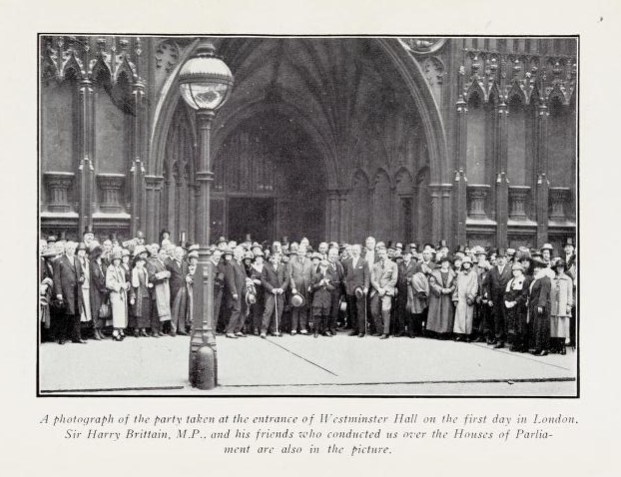
Canadian News Editors Party at Entrance to Westminster Hall, June 1924. Photo from Pilgrims of the Press.
Canadian News Editors at Entrance to Westminster Hall, June 1924. Photo from Pilgrims of the Press.

At long last, Christopher Alexander (C.A.) Fleming, educator and publisher in Owen Sound,  Ontario, was embarking on a voyage to the United Kingdom. The year was 1924 when Europe was rebuilding after the war of 1914-18.  Roy Fleming, his cousin, had emphatically recommended such a trip after his own in 1903.

C.A. – you know you are rich – you might cease from your labors for two months and take a trip to the Old Country and see these places – see that land of true beauty and sweet traditions – the land of your fathers,  which age will never dim. [Letter  dated  14 October 1903]

Arranged by the Canadian Weekly Press Association for editors of weekly newspapers, the tour covered Belgium, Paris, and the major cities in the United Kingdom.  There were 171 individuals in the party, of whom 101 were associated with some 100 weekly Canadian newspapers. Of these editors, 83 were men and 18 women. Seventy family members travelled with them. Many of the editors were from Ontario, and smaller numbers from the Atlantic provinces and the West. [Davies, “Who’s Who”]  

C.A. owned  the Daily Sun-Times and the weekly Cornwall Freeholder. His eldest daughter, Lillian, who was 37 and a kindergarten teacher, accompanied him on a trip that became the highlight of her life – especially the garden party at Buckingham Palace.

Over the eight weeks, C.A. mailed letters to the Daily Sun-Times with reports on the social events and the places – the streets, the people, the exhibits and tours. These were dense with descriptions of the farmlands and industrial sites and attentive to points that his Grey County readers would appreciate. He later published his reports as a collection in  Letters from Europe.

W. Rupert Davies, of The Renfrew Mercury in Renfrew, Ontario, and former president of the Association, organized the itinerary and meetings with dignitaries and press associations. He published his account in Pilgrims of the Press, in which he explained that this endeavor was to be  “an educational tour with the idea, not only of establishing a closer relationship between the weekly editors of Canada and the newspaper fraternity of the Old Land, but in order that we should all get first-hand knowledge of the Mother Country and some of its problems.” [Davies, p. 3] (Davies, who many years later was appointed to the Canadian Senate, brought his wife Florence  McKay and their son Robertson – the Robertson Davies who grew up to be a journalist and acclaimed novelist.)

The idea for conducting such an ambitious tour was rooted in a strong sentiment for the British Empire. The elite of the Empire Press Union and the Newspaper Society in England provided full support and likely direction. We might surmise that their motives were to strengthen diplomatic and economic bonds between Canada and Britain. Notwithstanding that Canada had just fought for “King and Country,” Canadians were pressing instead for autonomy and independence from imperial requests.

Continue reading
Dorothea Deans: “Women’s Editor”

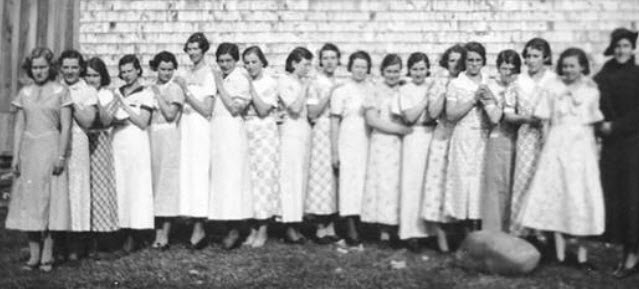
Group of Women at Bognor Hall. Date Unknown. Courtesy of The Grey Roots Archival Collection

We digress in this blog to shine a light on the woman who wrote the biography of  Christopher Alexander Fleming of Owen Sound, Ontario.  C.A. was a much loved and distinguished educator, auditor, and publisher in Grey and Bruce Counties.  After he died in April 1945, the Fleming family engaged Dorothea Deans to memorialize C.A.’s life and character. Dorothea, the women’s editor for the Sun Times in Owen Sound for over 20 years, was a perfect choice: She wrote well – her prose was warm, clear, and concise;  she had known C.A. thorough her work; and she had lived in that port city most of her life.

Family members would have provided Dorothea C.A.’s writings and correspondence, along with papers he and his cousin Roy Fleming had collected on family history. She must have interviewed many family members and business colleagues, and she could research many of his accomplishments in the newspapers.  In the first paragraph of the foreword, she laid out the scope of the work and nature of her subject carefully and reverentially.

This sketch of the life of Christopher Alexander Fleming is in no way an attempt at an interpretation of a man and his period. He is too close in time for that and too dear to family and friends to need translation. Rather, it is a record of facts about his hereditary background, his youth, and his long, productive years, gathered together like the photographs of an album, the acts of a play, the blueprints of a building. Somewhere, within the facts and the intangible things they imply, love and beauty, work and sacrifice, truth and aspiration, is the immortal personality. [1]

Continue reading

Researching Land Records in Ontario

Land records have been an important resource in documenting the history of the Fleming families in Derby Township, Grey County. The most useful record has been the “abstract index to deeds” adopted in the land record offices in 1865. The abstract is a summary of the transaction showing dates, instrument number, transaction type, lot and concession, acres, grantor and grantee, dollar amount. Transaction codes indicate “bargain and sale,” mortgage received, discharge of mortgage, release, grant, and other events. In a nutshell it shows the history of the changes in ownership and financing arrangements, and sometimes the disposal of an estate. For further detail, it was sometimes necessary to find the memorialization of the deed or transfer by the instrument number in the copybook for the township or locate the original document.

Previously, researchers had to go to the county land registry office or Archives of Ontario. Today the Ontario Land Registry Access (OnLand) website provides online access to digital images of the index pages. This posting is a short guide for searching that service.

Land records are organized by concession and lot. In our case, we knew the concession and lot numbers of the properties Alexander Fleming bought in 1847 and 1858. Another source for this information are farmers’ directories – especially the Gazetteer and Directory of the County of Grey  1865-6 (Toronto: W W Smith, 1865)

In this example, we are looking for the history of “Forest Lawn” on the north half of Lot 9 Concession 6. James Fleming obtained the lot from his father in 1853 and during his lifetime developed it into an estate of orchards and gardens. Continue reading

George Herbert Wyllie (1898-1970)

George Herbert Wyllie, son of Mary Fleming and George Wyllie of Kilsyth, ON,  was another young man of Fleming blood to join the Canadian Expeditionary Force during the Great War.

Fit, 5 feet 7 ¾ inches tall, 146 pounds, with blue eyes and fair hair, this strapping lad whose only blemish was a scar of three inches on the inner side of his left knee, walked into the Owen Sound recruitment office for the 147th Grey Overseas Battalion. The day was the 13th of May, 1916, four months to the day since he had turned 18 (on 14 January). Under the command of Lt. Col. G.F. McFarland, this battalion recruited 1,000 men during the winter of 1915-1916 and trained at Niagara-on-the-Lake and Camp Borden that summer. On November 14, 1916, Pte G. Herbert Wyllie, No. 839119, shipped out from Halifax on the RMS. Olympic.

Olympic_WWI
RMS Olympic as a troopship during First World War, WikiMedia Commons

Through the CEF Personnel Records and the War Diaries at Library and Archives Canada we have learned more about Herb’s service and experience. Continue reading

New York Heritage Digital Collection

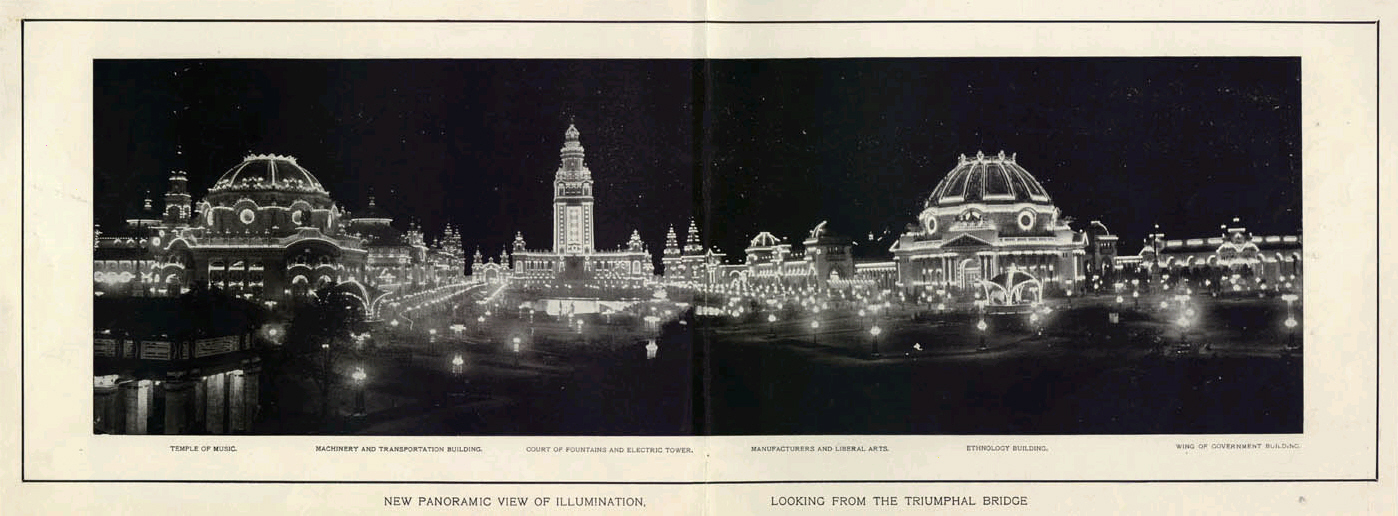
Photograph of the Pan Am Exposition of 1901 in Buffalo illuminated at night with latest technology for electrical wiring.
Panoramic View of the Pan-Am Exposition of 1901 in Buffalo. NY. Source Wikimedia  (1)

Several members of the Fleming family moved to cities in New York State in the late 1800s. Researching their movements and lives has led us to the trove of the New York Heritage digital collections (https://nyheritage.org/) created by eight members of the Empire State Library Network.

Two cousins – Jean Agnew, daughter of Jessie (Fleming) Agnew, and Margaret Fleming, daughter of James Fleming –  were among the first to enter new nursing programs being started in New York State in the 1880s.

Jean Agnew arrived in Rochester NY to begin her training at the Rochester City General Hospital around 1887. The Rochester City Hospital School of Nursing, the third nursing school in New York State, opened its doors in 1880. Continue reading