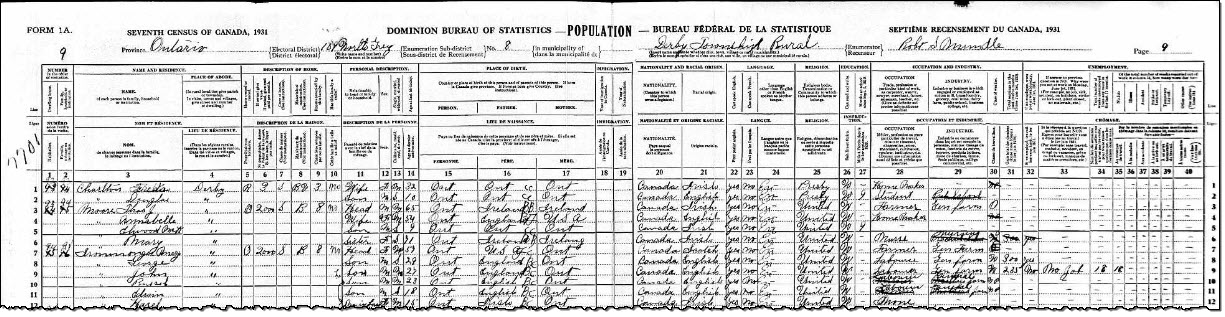
The event all genealogists in Canada have been waiting for has arrived: Library and Archives Canada released its digitization of 234,678 images of the 1931 Canada Census on June 1, 2023. The collection is open for browsing by location – province, district and sub-district. (1) Eight days later, Ancestry, using its Handwriting Recognition software, delivered a searchable indexed database to subscribers. Family Search will soon follow with its index. Images may also be browsed by province and district at FindMyPast.
The enumerators recorded details on more than 10.3 million people. Canada’s population after the First World War had grown 18% from the 8.7 million of 1921. Many immigrants were from Europe, attracted to agriculture in the Prairie provinces. At the same time and especially in Ontario the urban population surpassed the rural as men and women left farms to work in factories and offices. Trouble appeared in the late 1920s with crop failures in the west and the stock market crash of 1929 in the east. By 1931 the Great Depression had taken hold with rising unemployment, homelessness and hunger. By 1933 unemployment was 33%. During this time, the Prairies were beset by drought and insects to bring on the Dirty Thirties. Not all were devastated: property owners and people with jobs fared much better. These outcomes are captured in the data on house values, income, and employment. (2)
The Census provides a snapshot of how families were managing across the nation. Questions concerned housing, income, employment, ethnicity, nationality, education – and, very interestingly, possession of a radio.
Questions
Enumerators asked the head of the household forty questions covering (3):
Names and Addresses – the head of the household (usually a man), wife children, relatives, and boarders. Full address when possible.
The home – Whether they owned the house or rented – value if owned, monthly rent otherwise. The Class of home could be single family, apartment, semi-detached, boarding house, hotel. Construction materials (a question that was asked in nearly every census) – stone, wood, brick, stucco, concrete block – others. Number of rooms occupied. And new to 1931, the presence of a radio.
Personal details – names, relationship, gender, age as of June 1, marital status, place of birth for self and for both parents.
Immigration and ethnicity – immigration year or naturalization, nationality, ethnicity drawn from the father.
Language, religion, education – English French, other; religion; read and write; months at school since September 1939 for students 5 to 20 years of age.
Occupation – Occupation for those over 10 and if employed, what industry or business. Women were usually shown as Homemaker. Class of worker – employer, salary worker, self-employed – “on own account”, those family members who worked in the home for no pay. For wage earners, total earnings in last 12 months. Amount was not required for those “on own account” or with Income.
Unemployment – For salary workers, where employed on June 1, and reason if not employed such as illness, layoff. Number of weeks unemployed in past 12 months and number of weeks out of work because of no job, illness, accident, strike, layoff, other.
Summary Statistics
A compilation of statistics gives us a broad view of the population . (4)
- Canada’s population had grown to 10,376,786.
- Around 63% of the population were of working age, and 32% were younger than ten years. Only 6% were 65 and older.
- Ontario with 3.4 million people made up 33% of Canada’s population
- 99% of households were in private homes. 55% of the households owned their home.
- Of children aged 7 to 14, 80% were in school.
- The principal religion was Roman Catholic (41%). Next were Presbyterian, Methodist, Congregational grouping (28%), Anglican (16%) and Baptist (4%.) Many Flemings belonged to the much smaller Church of Christ, Disciples. The numbers for this church had dropped to 15,811, most (8,359) in Ontario. Grey County had a devoted 197 members. (5)
- More than 33% of those over age ten were gainfully employed – meaning that 66% were not.
- 33.9% of Canadian households had a radio
Detailed data and analysis is available through Government of Canada’s page listing the 13 volumes of analysis [https://publications.gc.ca/site/eng/9.832354/publication.html] Detailed table of contents available through University of Toronto library https://mdl.library.utoronto.ca/sites/default/public/mdldata/open/canada/national/statcan/census/1931/doc/1931.pdf
Radio Enters the Home

Notwithstanding the depression, a radio craze swept the country. Early adopters bought radio sets (aka wireless) in the early 1920s. Sales soared such that by 1931 there were 173,200 sets in Canada. By 1932 there were 77 commercial radio stations bringing news, music, entertainment, sports, and political debate into the home. It was the Internet of the day.
The United States asked the same question in its 1930 Census and found that 40% of their households owned a radio. There was some suspicion, according to a news article, that this was a trick for the government to charge a fee. Not so, the question was to help in analyzing Canada’s radio audience for planning public broadcasting as well to get a measure of standard of living. Tabulation for the Census showed that 33.8% of Canadian households had a radio, and 44.7 of household in Ontario. In both cases, urban populations made up more than 55%.
Subsequently, the Canadian Radio Broadcasting Commission was established in 1932 as the first public broadcaster. By 1934 the US had four broadcasting networks. (6)
Next Time – About the Flemings
My project in this blog will be to examine snapshots the 1931 Census gives us of the lives of the Fleming families, Finch and Agnew.
This will be in four parts to cover the nine branches of the Fleming family.
1 Isabella Finch, Jessie Agnew
2. John and James Fleming – the twins
3. Alexander and Donald Fleming
4 William , Charles, Jennie Fleming
References
[1 ] To search for pages to browse at Library and Archives Canada go to https://recherche-collection-search.bac-lac.gc.ca/eng/Census/Index1931]
[2 ] Struthers, James. “The Great Depression in Canada,” The Canadian Encyclopedia, Aug 13 2021) https://www.thecanadianencyclopedia.ca/en/article/great-depression
[3 ] Hogan, Kathryn Lake. “Your Guide to the 1931 Census of Canada,” Family Tree, (updated May 2023) https://familytreemagazine.com/heritage/canadian/1931-census-canada/
[4 ] 1931 Census of Canada, Family Search (n.d – presume 2023) https://www.familysearch.org/en/info/1931-census-of-canada
[5] The numbers about the Disciples was taken from Bulletin No XXI, Population of Canada 1931, By Religious Denominations, pp 20-23 —https://publications.gc.ca/collections/collection_2017/statcan/CS98-1931B-21.pdf
[6] Radio References.
“Golden Age of Radio”, Wikipedia
https://en.wikipedia.org/wiki/Golden_Age_of_Radio
Dominion Bureau of Statistics, Seventh Census of Canada, 1931, Vol V Census, published in 1937, pp 979-980 https://publications.gc.ca/collections/collection_2017/statcan/CS98-1931-5.pdf
McKenlay, Ken. “1931 Census of Canada – Do you have a radio?” Family Tree Knots (Jul 3, 2023)– https://familytreeknots.blogspot.com/2023/07/1931-census-of-canada-do-you-have-radio.html
Smith, Stephen. “Radio, the Internet of the 1930s”, APMReports (Nov 10, 2014
https://www.apmreports.org/episode/2014/11/10/radio-the-internet-of-the-1930s
Postscript 24 November 2023
From Genealogy a la carte by Gail Dever (Nov 23, 2023) — 1931 Canada Census now searchable on Library and Archives Canada’s website
 The Flemings of Derby Township