The existence of a tartan for the Fleming clan is in question.
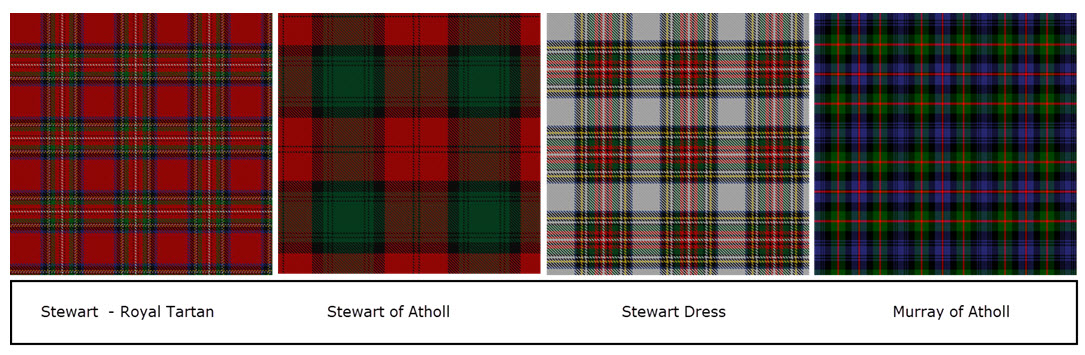
Of three tartan finders on the web, only Clan.com purports to present a unique, blue Fleming tartan, stating that Murray and Sutherland tartans might also be used. Scotclans shows a Murray of Atholl as a Fleming tartan with the note, “There is no registered Fleming clan tartan. However, as a sept of Clan Murray of Atholl, Flemings, and those associated with the name, can wear the Murray of Atholl tartans.” The Clan Fleming Scottish Society declared this sept a myth created by tartan vendors. Scotlands Shop comes up empty on a search for Fleming.
Further, Scottish clan maps do not list a Fleming clan. We note, however, that the clans Stewart and Murray are present in the Perthshire area, where Alexander Fleming and his wife, Jean Stewart, lived in the early 1800s. See the Scottish clan map on Wikipedia.
What are tartans, and why are they associated with clans?
Tartans are patterned cloths of horizontal and vertical bands in multiple colours. Traditionally, the material was hand-woven from wool. Worn in Scotland for centuries with localized patterns, a red tartan might be most remembered as the garb worn by the army of Charles Stuart, aka Bonnie Prince Charlie, at the Battle of Culloden 1746 – a battle they lost at great cost to the English. Afterwards, the English banned the Scottish from wearing tartan, an act not repealed until 1782. Several writers credit King George IV and later Queen Victoria with reviving the Highland Dress. During their reigns, tartans became more available. Industrialization in the late 1700s led to the proliferation of tartan patterns and products. Association with specific clans followed in the 1800s, ultimately with significant marketing benefits.
As explained at the Scottish Tartan Museum – “Part of this process was the identification of a tartan with the family, clan, or place whose name it bore. This was a development of tradition that was encouraged by the chiefs of the clans. Stripped of any political power, one of the few remaining prerogatives of the chief was what tartan would represent his clan.“
Is Fleming a clan?
Here’s the rub: The Fleming clan, which originated in the Lowlands, has not had a chief since the last one died in 1747. Thus, the clan is armigerous and not recognized as a community by Scots Law. As the recently formed (2023) Clan Fleming Scottish Society observed, Fleming tartans “originated with vendors of clan merchandise.” However, the lack of recognition for a Fleming tartan may soon change. The Society is working to resurrect the clan and establish an actual Fleming tartan.
What does this mean for a descendant of Alexander Fleming and Jean Stewart?
Alexander Fleming (1799-1869) wore the Royal Stewart tartan — Stewart was the dominant clan in the Logeirait district, and his wife Jean (1803-1888) was a Stewart. Ruth (Fleming) Larmour, GG granddaughter of Alexander, and her family proudly use the Royal Stewart tartan.
But the choice is up to the individual. The Scottish Tartan Museum advises all to select what they like.
“Even today, there are no rules or regulations dictating Highland fashion or tartan choice. The most “traditional” thing you can do is to select a tartan based on its appearance rather than its name! However, tartans today do represent things, whether a clan, family, city, business, or event. Most people choose to wear a tartan that represents some part of their own heritage. In the end, though, that choice is completely up to you.”
 The Flemings of Derby Township
