A family history of the Flemings who came from Perthshire in 1843 to settle in Derby Township, Grey County. We follow the family into the mid 1900s as they dispersed across North America..
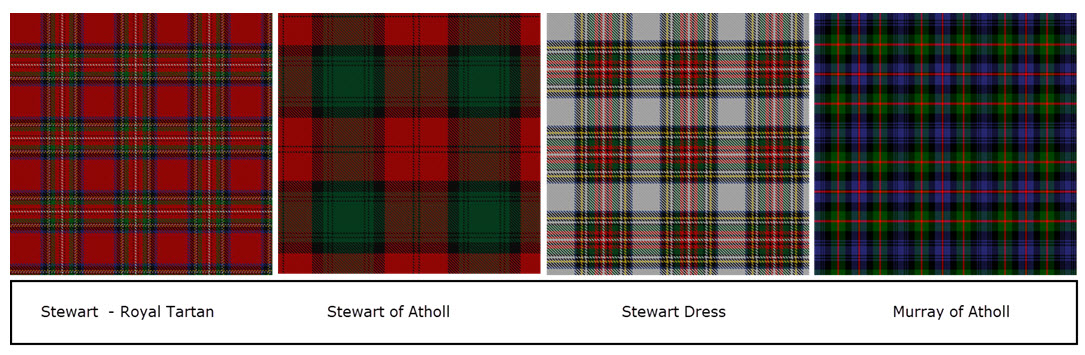
Further, Scottish clan maps do not list a Fleming clan. We note, however, that the clans Stewart and Murray are present in the Perthshire area, where Alexander Fleming and his wife, Jean Stewart, lived in the early 1800s. See the Scottish clan map on Wikipedia.
What are tartans, and why are they associated with clans?
The table of contents links to each chapter, and the text is searchable by keyword. The book can be found most easily by searching by title: Flemings of Derby Township. The subject headings may also be helpful: Fleming family, family history, genealogy, Derby – Township – Grey County, Owen Sound – Ontario, Canada West, Church of the Disciples of Christ, Pioneer Life 1840-1880, Logierait, – Perthshire – Scotland, Scottish emigration to Canada, Christopher Alexander (C.A.) Fleming, Roy F. Fleming.
The Creative Commons license for usage rights is for Attribution-NonCommercial-NoDerivatives 4.0 International. Material may not be used for commercial purposes or remixed for distribution. To view a copy of this license, visit http://creativecommons.org/licenses/by-nc-nd/4.0/
The print book and some e-copies may also be viewed at the following:
Toronto Public Library, Reference Library – one print copy
Owen Sound & North Grey Union Public Library (https://www.osngupl.ca/) – two copies for in-library use.
Grey Roots Museum and Archives, Owen Sound, ON (https://greyroots.com/) – two copies and one e-copy. Search for Flemings of Derby Township, 2022 year of creation. Contact the archive.
Bruce County Museum and Cultural Centre, Southampton, ON (https://www.brucemuseum.ca/) – one print copy and one e-copy. Search for Flemings of Derby Township, date =2022.. Contact the archive.
Archives and Collections, University of Guelph – one print copy
Ontario Genealogical Society (https://ogs.on.ca/) – the Society Library is kept at the Humanities and Social Sciences Division at the Toronto Reference Library.
Carrying a sectional boat – 1914 – Rod and Gun in Canada
While researching the life of C.A. (Christopher Alexander) Fleming (1857-1945) for the Flemings of Derby Township: A family history, I learned that C.A. had designed and built a boat that could be separated into parts for easier travelling on hunting trips. (1) But I had no further information on shape or size or even usefulness. By good fortune, I came upon an article that C.A. wrote in 1914 describing the boat and wondered if this type of boat is made today.
C.A. Fleming, educator, publisher and banker in Owen Sound, Ontario, was at heart a “master hobbyist,” as we know from his biographer, Dorothea Deans. She drew attention to C.A.’s skills with all tools, adeptness with machinery, and early adoption of camera and radio. “He had the inventiveness of a pioneer,” she wrote. (2)
He was also an avid outdoorsman, travelling into remote areas for hunting with the Striker Club in the late 1800s and early 1900s. My surprise was to find the article he wrote in 1914 in Rod and Gun in Canadain the Internet Archive.
Modestly, he explained in the opening paragraph: “The writer began experimenting about two years ago on boats that could be easily made by any handyman, that were light and tight, easily transported by train or vehicle, easily portaged, stored in a small space, and quite safe for any inexperienced person to handle.; and succeeded in building one that filled the conditions aimed at.” (3)
In the article, C.A. gave detailed instructions and parts lists for constructing a 13-foot-7-inch boat with a 42-inch beam weighing about 90 lbs. It could also serve as a motorboat with the addition of the Waterman outboard motor.
C.A. claimed that taking the boat apart was nearly dead simple: “… [I]t was very little trouble to take apart —we had only to take out eight bolts and separate it into three sections. We found no trouble in carrying it back two miles through the bush to a lake where the deer were taking to the water. The portable boat and the portable engine made a fine combination for the hunting grounds.” Being in segments, the boat, he found, was easy to load onto a train, could be packed with camping goods, and could be carried in portages.
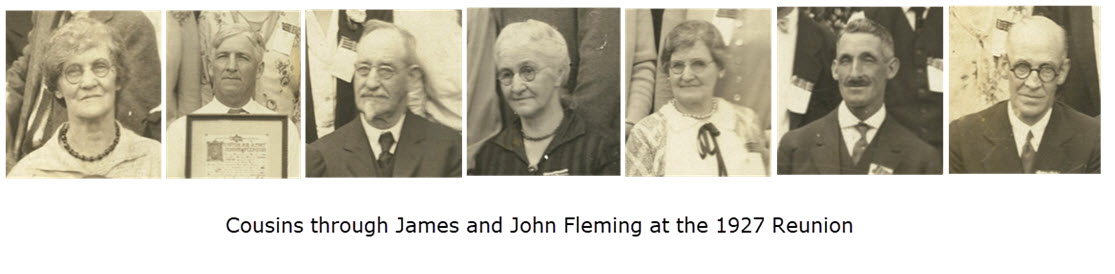
James and John – “the twins” – died within a year of each other: John in Kilsyth in 1909 and James in Owen Sound in 1910. John had nine children, all living in 1931, of whom only Alfred (or T.A.) had his career in the United States. The others stayed in Ontario. In contrast, of James’ nine surviving children, only Mary Ella [Wyllie] was nearby in Kilsyth. Alexander, his eldest son, was in Regina, Saskatchewan. The others had headed mainly to California.
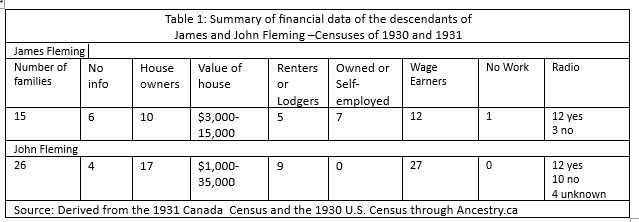
The data gathered in this posting are about James and John’s children and adult grandchildren. The 1931 Canada Census and the 1930 U.S. Census indicate the financial well-being of the families and single independents. Surprisingly, of the 41 families and singles in this tabulation, only one person was unemployed. A few worked independently (7); most were wage earners, especially in John’s line. For those who owned their houses – and most did – values ranged from $1,000 to 35,000. Values for the seven U.S. properties are at the higher end. In Canada, rural and small-town living lowered the average. Radio sets were in nearly every home in cities but missing on farms and some apartments.
In reviewing the lives of the descendants of Alexander Fleming and Jean Stewart, we begin with the families of their daughters: Isobel (1825-1917), married to Abraham Finch, and Janet (1828-1918), to James Agnew. They and several of their children had died before 1931, but we can see through the 1931 Census how the younger ones and their children were faring in the strained economic times of the early 1930s. Nearly all were far from Grey County in diverse occupations across the continent – only a couple were still farming. Several owned their houses, mostly made of wood, and some had radios.
The Finches
The effervescent Bella [Herald], who had moved to Ontario’s Parry Sound district, died in 1923. Her beloved adopted son William Herald, who had survived the battles in Europe, settled in Parry Sound to work as a salesman in a general store and begin a family with Annie Lang.
Isobel’s daughter Jessie[Trout] was 80 years old in 1931 and widowed. She and her daughter Ella (Isabella) resided at 78 Dawson Street in Wiarton, where they shared an eight-room wood house valued at $1000. Ella was 57 and living on “income,” perhaps from savings from her years in Toronto as a public school teacher. There was no radio in their house.
Alexander Heneage Finch, a Disciple minister and Manitoba farmer, died in 1920. Widowed Sophie (de la Ree) lived in Winnipeg with her daughter’s family: Thomas Babb, Beatrice, and the four-year-old Reginald. The Babbs rented their five-room wood house on Ashburn Street, and they did have a radio. Thomas taught, possibly at a high school.
Most of Sophie’s and Alexander’s children were alive in 1931, all but two residing in Alberta.
Horace, an insurance agent, had a house for his wife and two daughters in Wetaskiwin, AB., near Edmonton.
Bertram, a farmer in Minitonas in the Swan River region of Manitoba where he had grown up, worked for his father-in-law, John Smith.
Percival was a salesman for a lumber yard in Viking, AB. He, his wife and daughter, rented a wood house and were among the few with a radio.
Norman managed a lumber yard in Clyde AB, where he owned a four-room house for his wife and two daughters. They had a radio.
Alexander was a carpenter in house-building in Mirror, AB. His small family also lived in a wooden house they owned. Alexander was currently out of work.
Carlos “Carl” managed a retail lumber yard in Irma, AB. Single, he lodged with a family.
Cecil was not enumerated, but other records suggest Alberta or Manitoba.
Ruby Mae, married to Martin Danard, was probably living in Flin Flon, MB, where three children were born. The family was missed in the 1931 census.
James, at age 25, was in Winnipeg, married, and working as an electrician. He and Katherine rented a two-room apartment and had a radio.
Isobel’s next son William died from influenza in Winnipeg in 1918. Several of his and Martha’s children lived in Winnipeg – Earnest, Robert, and Olive [Rhodes] are three who were enumerated. Others, though alive, were missed.

 The Flemings of Derby Township
