A Trip of a Lifetime

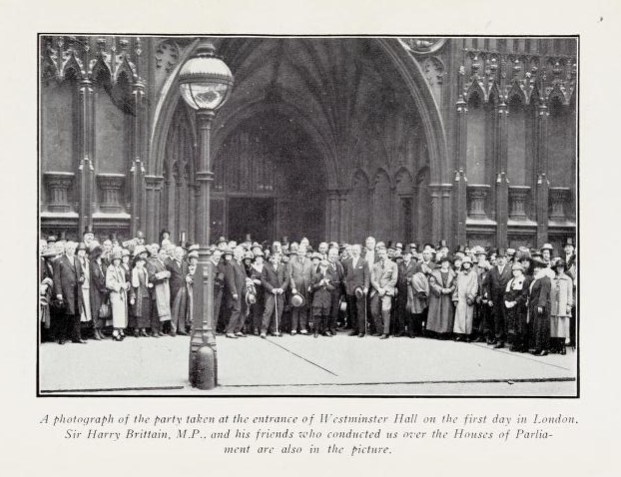
Canadian News Editors Party at Entrance to Westminster Hall, June 1924. Photo from Pilgrims of the Press.
Canadian News Editors at Entrance to Westminster Hall, June 1924. Photo from Pilgrims of the Press.

At long last, Christopher Alexander (C.A.) Fleming, educator and publisher in Owen Sound,  Ontario, was embarking on a voyage to the United Kingdom. The year was 1924 when Europe was rebuilding after the war of 1914-18.  Roy Fleming, his cousin, had emphatically recommended such a trip after his own in 1903.

C.A. – you know you are rich – you might cease from your labors for two months and take a trip to the Old Country and see these places – see that land of true beauty and sweet traditions – the land of your fathers,  which age will never dim. [Letter  dated  14 October 1903]

Arranged by the Canadian Weekly Press Association for editors of weekly newspapers, the tour covered Belgium, Paris, and the major cities in the United Kingdom.  There were 171 individuals in the party, of whom 101 were associated with some 100 weekly Canadian newspapers. Of these editors, 83 were men and 18 women. Seventy family members travelled with them. Many of the editors were from Ontario, and smaller numbers from the Atlantic provinces and the West. [Davies, “Who’s Who”]  

C.A. owned  the Daily Sun-Times and the weekly Cornwall Freeholder. His eldest daughter, Lillian, who was 37 and a kindergarten teacher, accompanied him on a trip that became the highlight of her life – especially the garden party at Buckingham Palace.

Over the eight weeks, C.A. mailed letters to the Daily Sun-Times with reports on the social events and the places – the streets, the people, the exhibits and tours. These were dense with descriptions of the farmlands and industrial sites and attentive to points that his Grey County readers would appreciate. He later published his reports as a collection in  Letters from Europe.

W. Rupert Davies, of The Renfrew Mercury in Renfrew, Ontario, and former president of the Association, organized the itinerary and meetings with dignitaries and press associations. He published his account in Pilgrims of the Press, in which he explained that this endeavor was to be  “an educational tour with the idea, not only of establishing a closer relationship between the weekly editors of Canada and the newspaper fraternity of the Old Land, but in order that we should all get first-hand knowledge of the Mother Country and some of its problems.” [Davies, p. 3] (Davies, who many years later was appointed to the Canadian Senate, brought his wife Florence  McKay and their son Robertson – the Robertson Davies who grew up to be a journalist and acclaimed novelist.)

The idea for conducting such an ambitious tour was rooted in a strong sentiment for the British Empire. The elite of the Empire Press Union and the Newspaper Society in England provided full support and likely direction. We might surmise that their motives were to strengthen diplomatic and economic bonds between Canada and Britain. Notwithstanding that Canada had just fought for “King and Country,” Canadians were pressing instead for autonomy and independence from imperial requests.

Continue reading
New York Heritage Digital Collection

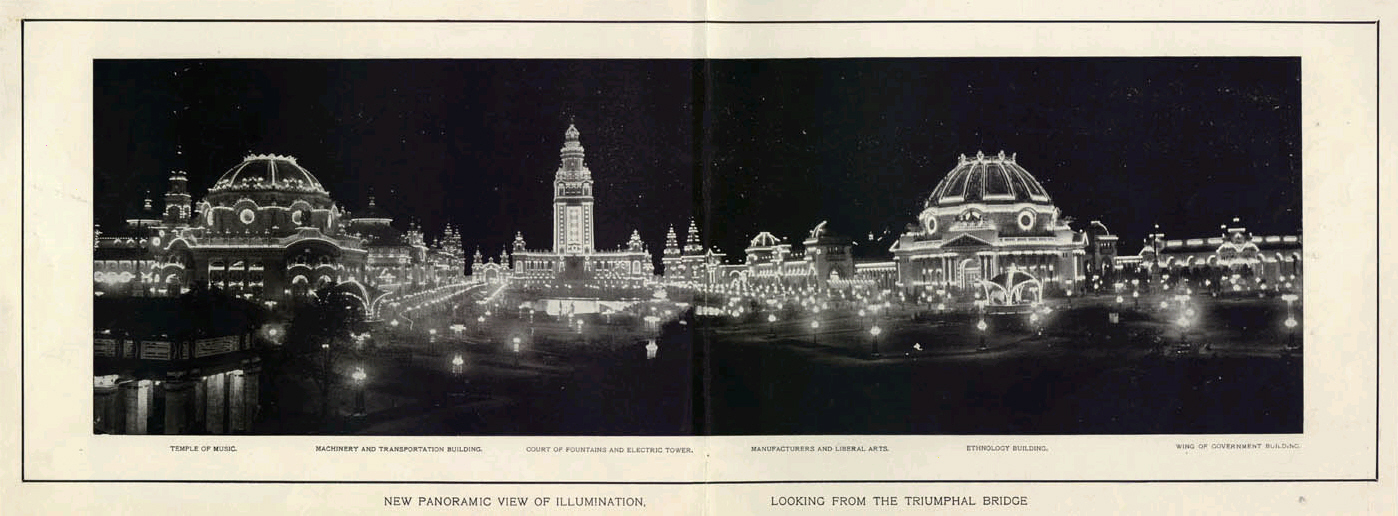
Photograph of the Pan Am Exposition of 1901 in Buffalo illuminated at night with latest technology for electrical wiring.
Panoramic View of the Pan-Am Exposition of 1901 in Buffalo. NY. Source Wikimedia  (1)

Several members of the Fleming family moved to cities in New York State in the late 1800s. Researching their movements and lives has led us to the trove of the New York Heritage digital collections (https://nyheritage.org/) created by eight members of the Empire State Library Network.

Two cousins – Jean Agnew, daughter of Jessie (Fleming) Agnew, and Margaret Fleming, daughter of James Fleming –  were among the first to enter new nursing programs being started in New York State in the 1880s.

Jean Agnew arrived in Rochester NY to begin her training at the Rochester City General Hospital around 1887. The Rochester City Hospital School of Nursing, the third nursing school in New York State, opened its doors in 1880. Continue reading

Online Newspapers in Canada

Why Toronto Mothers Oppose Daylight Savings - 1923 - vintage ad
From Toronto Telegram, 31 December 1923, posted to Flickr – https://www.flickr.com/photos/jbcurio/14133682628

My favourite research source, bar none,  is the newspaper for that time and place – often  a storehouse of social announcements and background on issues and concerns. My greatest frustration arises from the huge holes in the digitization of Canadian newspapers – parts of Ontario have never been touched, and secondly, in the usually klutzy search interfaces –  access through Proquest  for the Globe and Mail and Toronto Star Archives comes to mind. Putting that aside, there is one major collection site to use as a starting point for online newspapers and one recent news item.

The Ancestor Hunt maintains a page of links to newspapers in the United States and Canada, and links to collections in Australia, Europe, and the Caribbean. It also provides thirteen lessons on best ways to search online newspapers and other informational articles.

John Reid at Canada’s Anglo-Celtic Connections also keeps an eye for announcements concerning digital Canadian newspapers, the latest being Canadian Newspapers on the British Newspaper Archives (14 February 2020). He reminds us that Canadiana Online and Google Newspapers also hold some publications.

Oh – would that we had a Canadian Newspaper Archives online!

Postscript 20 February 2020: The blog entry of The British Newspaper Archive – Hot Off The Press for 17 February – describes more fully their new additions of the Toronto Daily Mail, Hamilton Daily Times, and Saturday Night spanning years 1875 to 1920.  Stated reason was “these newspapers are a useful resource for people with ancestors who emigrated, whilst illuminating a time of great change and growth in the North American country.” Yes – an archive to watch – maybe they’ll add more.

A Scottish New Year

Scottish New Year Greetings.
Scottish Hogmanay Greetings.

Happy and Healthy New Year for 2020

The Scots are famous for Hogmanay – a New Year’s Eve and Day celebration for visiting and  gift-giving and certainly the singing of Auld Lang Syne by the much beloved Robert Burns and a gift of the Scots to the world.

Sadly, we have no accounts on how Alexander and Jean Fleming or any of their children celebrated the season, but, given the love Roy Fleming and his aunt Jennie Fleming had for Robbie Burns, we may safely assume they sang all the verses.

Chorus:
For auld lang syne, my dear,
For auld lang syne.
We’ll tak a cup o’ kindness yet,
For auld lang syne (1)

Several Flemings had musical interests and were blessed with considerable talent: James and his brother William sold organs in the late 1800s in Owen Sound, Isabella Finch’s son, William, worked as “music dealer” in Brandon Manitoba, and his two sons – William Everett and Robert Lincoln – were musicians, James’s daughter Minnie became a music teacher, Charles’ daughter Annie played the piano, James great-granddaughter Nancy (Hayes) Van de Vate composed opera and orchestral works. There were surely others.

At New Year’s the Fleming families may have gathered around an organ to sing the “Hogmanay Song” by Peter Livingstone (1823-1851) written to greet the new year in the same spirit as Burns’ song but without the drams of whiskey that the temperance- abiding Flemings would have abstained from.

A guid New Year to ane an a’
And mony may you see,
An during the years that come,
O happy you may be. (2)

The Christmas of decorated trees, gifts, and feasts was not observed by the Scots until relatively recently. At the time of John Knox and the Reformation (1560), the Scottish government abolished Christmas and had no quarrel with the Puritan regime of Oliver Cromwell in 1643 when  all Christmas festivities and merrymaking were banned. After the restoration of the monarchy in 1660, Christmas celebrations were resumed in England but not Scotland, where the Church of Scotland continued to regard everything related to Christmas as papist. Christmas celebrations were curtailed for another 400 years, and it wasn’t until 1958 that Christmas Day became a public holiday in Scotland. (4,5,6)

No matter – the Scots had Hogmanay (New Year’s Eve) and New Year’s Day as their time for revelry and visiting. These festivities were centuries-old, some originating with the Norse.

Victuals were prepared long in advance. Dorothy Duncan, in Canadians at Table: Food, Fellowship, and Folklore: A Culinary History of Canada, identified several popular dishes seen on Canadian tables: Black Bun – a plum cake encased in pastry, shortbread baked in a large circle and cut into wedges, oat cakes, scotch eggs – “hard-boiled eggs, peeled and wrapped in sausage meat, then rolled in crumbs and deep-fried,” and haggis served with potatoes and turnip. (7)

The Scots visited friends and family during the eve and into the next day taking with them a small, symbolic present – salt for flavour, coal or peat for warmth, shortbread for food, and a dram or two for cheer – and were warmly welcomed with food and beverage. There could be singing and dancing as part of the Ceilidh (social gathering). It mattered who was the first person after midnight to set foot across the threshold: In the tradition of “first footing,”  a tall, dark-haired man would bring good luck and prosperity, a redheaded man or a woman would bring bad luck. (4,5,6)

Ken McGoogan, author of How the Scots Invented Canada, noted the elements of fire and superstition in the celebrations:

This Scottish celebration starts on New Year’s Eve and runs through the next day and sometimes longer. Scotland’s national poet, Robbie Burns, once revelled in Hogmanay festivities that spun out of control: the house caught fire and burned to the ground, costing him both his residence and his job. Possibly this resulted from “redding the house,” a Scottish-Viking tradition that means burning juniper branches in the house until it fills with smoke, then opening the windows to cast out evil spirits. (3)

Another superstition that McCoogan offers is that, “to rid the house of bad feeling among friends or relations, you can burn branches from a rowan tree.” The Flemings may have remembered that there were two rowan trees at their Kirrandrum home in Perthshire.

References:

  1. Poets.org Auld Lang Syne by Robert Burns.
  2. A Little Book of Hogmanay by Bob Pegg (2013) Google Books
  3. “How the Scots Get Ready for the Holidays” in SavvyReader  via Archive.org (30 Nov 2010) by Ken McGoogan
  4. Scottish Christmas Traditions by Tracey Kelly (n.d.)
  5. Holidays: Hogmanay (Dec 31 – Jan 2) (n.d.) in A Song in Thy Praise: Windsor’s Scottish Heritage – Windsor Public Library.
  6. Hogmanay: A Scottish New Year Celebration by J. Winter (1 Jan 2015), in Upper Canada Scots
  7. Dorothy Duncan. Chapter 18, Canadians at Table: Food, Fellowship, and Folklore: A Culinary History of Canada. (Dundurn: September 2011) Google Books.

Vernon’s Owen Sound City Directories

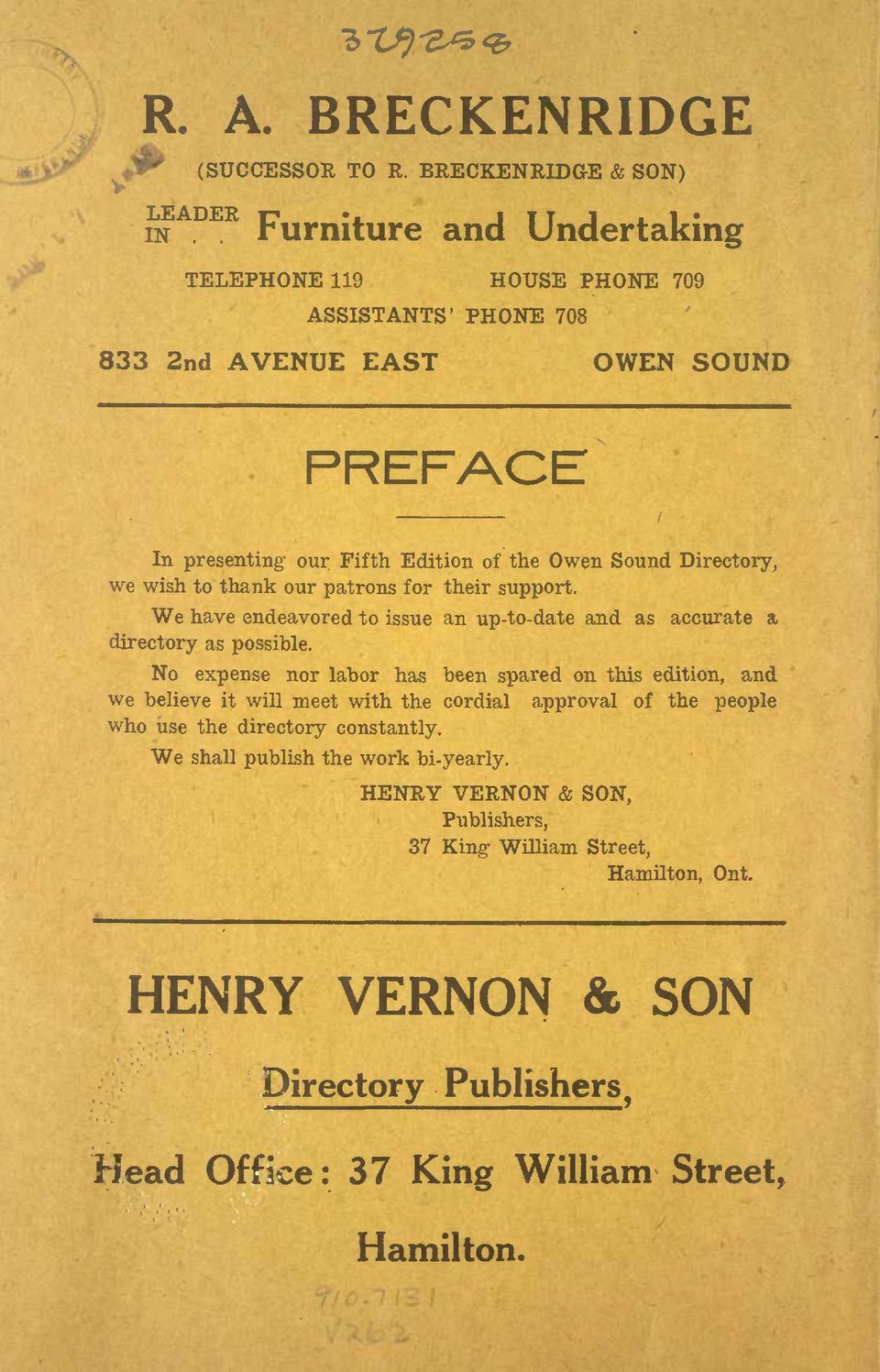
Page from Vernon's Directory for Owen Sound 1917
Page from Vernon’s Directory for Owen Sound 1917

People researching residents and businesses in Owen Sound may now go to Family Search to use digitized copies of Owen Sound Vernon city directories for the years: 1942, 1961, 1964,  1991, 1997/98, 2001/02. Search Family Search > Books (https://www.familysearch.org/library/books/records/) for owen sound to see the selection. This tremendous project of the Ontario Genealogical Society is described in this announcement –  Vernon Directory Digitization Project (February 18, 2019). Let’s hope that more of the earlier years are added soon.

The 1917 Vernon directory for Owen Sound that is held by the Toronto Public Library directory has been digitized and is at both the Internet Archive and at Toronto Public Library site.

Postscript 23 Nov 2019 – Gail Dever (Genealogy à la carte) in Dozens more Ontario Vernon’s Directories on FamilySearch describes the project and briefly, the search. For example: “a free FamilySearch account is required to view each individual directory. ”

Postscript 28 Dec 2019 – Digitized years now available are: 1928, 1930,1932,1936, 1938,1940,1942, 1958, 1961,1964, 1968, 1970, 1972, 1974, 1977,1979, 1981, 1983, 1985,1987, 1989, 1991, 1993/94, 1995/96, 1997/98, 1999/2000, 2001/02, 2003/04, 2005/06.