C.A. Fleming and the Sectional Boat

photo of four men carrying three parts of a sectional boat built by C.A. Fleming   he and fellow hunters used in the Algoma district in the early 1900s.
Carrying a sectional boat – 1914 – Rod and Gun in Canada

While researching the life of C.A. (Christopher Alexander) Fleming (1857-1945) for the Flemings of Derby Township: A family history, I learned that C.A. had designed and built a boat that could be separated into parts for easier travelling on hunting trips. (1) But I had no further information on shape or size or even usefulness. By good fortune, I came upon an article that C.A. wrote in 1914 describing the boat and wondered if this type of boat is made today.

C.A. Fleming, educator, publisher and banker in Owen Sound, Ontario, was at heart a “master hobbyist,” as we know from his biographer, Dorothea Deans. She drew attention to C.A.’s skills with all tools,  adeptness with machinery, and early adoption of camera and radio. “He had the inventiveness of a pioneer,” she wrote. (2)

He was also an avid outdoorsman, travelling into remote areas for hunting with the Striker Club in the late 1800s and early 1900s. My surprise was to find the article he wrote in 1914 in Rod and Gun in Canada in the Internet Archive.

Modestly, he explained in the opening paragraph: “The writer began experimenting about two years ago on boats that could be easily made by any handyman, that were light and tight, easily transported by train or vehicle, easily portaged, stored in a small space, and quite safe for any inexperienced person to handle.; and succeeded in building one that filled the conditions aimed at.” (3)

In the article, C.A. gave detailed instructions and parts lists for constructing a 13-foot-7-inch boat with a 42-inch beam weighing about 90 lbs. It could also serve as a motorboat with the addition of the Waterman outboard motor.

C.A. claimed that taking the boat apart was nearly dead simple: “… [I]t was very little trouble to take apart —we had only to take out eight bolts and separate it into three sections. We found no trouble in carrying it back two miles through the bush to a lake where the deer were taking to the water. The portable boat and the portable engine made a fine combination for the hunting grounds.” Being in segments, the boat, he found, was easy to load onto a train, could be packed with camping goods, and could be carried in portages.

Continue reading
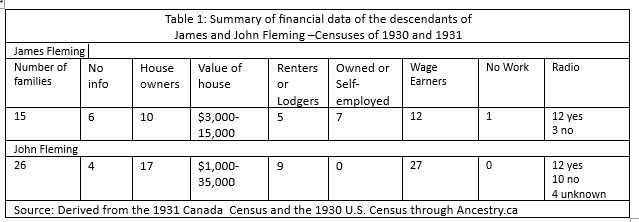
1931 Canada Census: Families of James and John Fleming

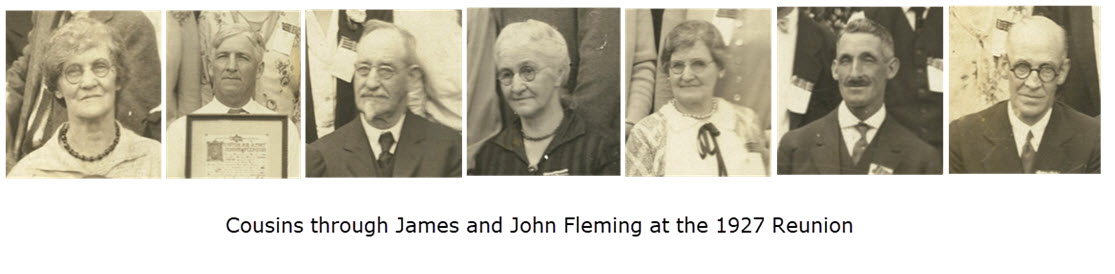
James and John – “the twins” –  died within a year of each other: John in Kilsyth in 1909 and James in Owen Sound in 1910. John had nine children, all living in 1931, of whom only Alfred (or T.A.)  had his career in the United States. The others stayed in Ontario. In contrast, of James’ nine surviving children,  only Mary Ella [Wyllie] was nearby in Kilsyth. Alexander, his eldest son, was in Regina, Saskatchewan. The others had headed mainly to California.

The data gathered in this posting are about James and John’s children and adult grandchildren. The 1931 Canada Census and the 1930 U.S. Census indicate the financial well-being of the families and single independents. Surprisingly, of the 41 families and singles in this tabulation, only one person was unemployed. A few worked independently (7); most were wage earners, especially in John’s line. For those who owned their houses – and most did – values ranged from $1,000 to 35,000. Values for the seven U.S. properties are at the higher end. In Canada, rural and small-town living lowered the average. Radio sets were in nearly every home in cities but missing on farms and some apartments.

Continue reading

1931 Canada Census: Families Finch and Agnew

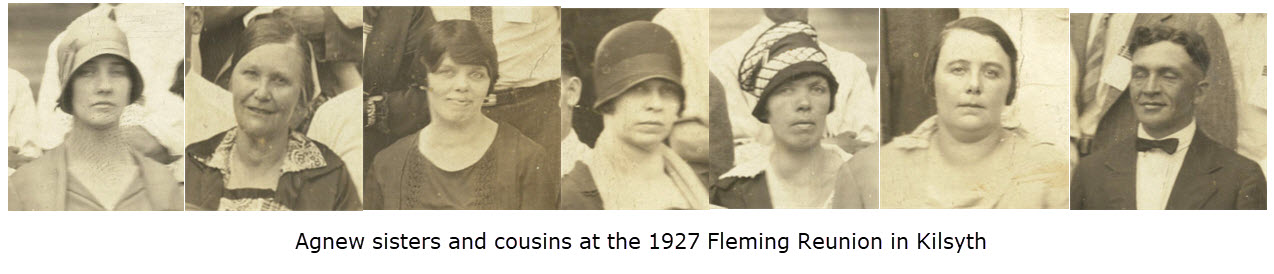
Excerpts from a photograph of the 1927 Fleming Reunion. These are descendants of Jessie (Fleming) Agnew.

In reviewing the lives of the descendants of Alexander Fleming and Jean Stewart, we begin with the families of their daughters: Isobel (1825-1917), married to Abraham Finch, and Janet (1828-1918), to James Agnew. They and several of their children had died before 1931, but we can see through the 1931 Census how the younger ones and their children were faring in the strained economic times of the early 1930s. Nearly all were far from Grey County in diverse occupations across the continent – only a couple were still farming. Several owned their houses, mostly made of wood, and some had radios.

The Finches

The effervescent Bella [Herald], who had moved to Ontario’s Parry Sound district, died in 1923. Her beloved adopted son William Herald, who had survived the battles in Europe,  settled in Parry Sound to work as a salesman in a general store and begin a family with Annie Lang.

Isobel’s daughter Jessie[Trout] was 80 years old in 1931 and widowed. She and her daughter Ella (Isabella) resided at 78 Dawson Street in Wiarton, where they shared an eight-room wood house valued at $1000. Ella was 57 and living on “income,” perhaps from savings from her years in Toronto as a public school teacher. There was no radio in their house.

Alexander Heneage Finch, a Disciple minister and Manitoba farmer, died in 1920. Widowed Sophie (de la Ree) lived in Winnipeg with her daughter’s family: Thomas Babb, Beatrice, and the four-year-old Reginald. The Babbs rented their five-room wood house on Ashburn Street, and they did have a radio.   Thomas taught, possibly at a high school.

Most of Sophie’s and Alexander’s children were alive in 1931, all but two residing in Alberta.

  • Horace, an insurance agent, had a house for his wife and two daughters in Wetaskiwin, AB., near Edmonton.
  • Bertram, a farmer in Minitonas in the Swan River region of Manitoba where he had grown up, worked for his father-in-law, John Smith.
  • Percival was a salesman for a lumber yard in Viking, AB. He, his wife and daughter, rented a wood house and were among the few with a radio.
  • Norman managed a lumber yard in Clyde AB, where he owned a four-room house for his wife and two daughters. They had a radio.  
  • Alexander was a carpenter in house-building in Mirror, AB. His small family also lived in a wooden house they owned. Alexander was currently out of work.  
  • Carlos “Carl” managed a retail lumber yard in Irma, AB. Single, he lodged with a family.
  • Cecil was not enumerated, but other records suggest Alberta or Manitoba.
  • Ruby Mae, married to Martin Danard, was probably living in Flin Flon, MB, where three children were born. The family was missed in the 1931 census.
  • James, at age 25, was in Winnipeg, married, and working as an electrician. He and Katherine rented a two-room apartment and had a radio.        

Isobel’s next son William died from influenza in Winnipeg in 1918. Several of his and Martha’s children lived in Winnipeg – Earnest, Robert, and Olive [Rhodes] are three who were enumerated. Others, though alive, were missed.

Continue reading

The Legacy of Ancestors

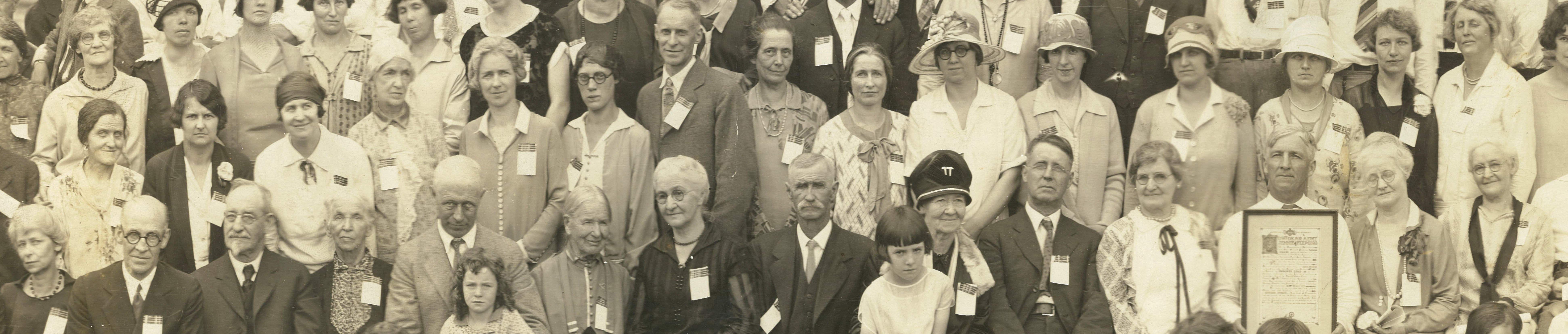
Excerpt from photograph of the 1927 Fleming Family Reunion in Kilsyth, ON
Excerpt from a photograph of the 1927 Fleming Family Reunion held at Springfield Farm, Kilsyth, ON. (Fleming Family Papers)

People have asked us: “why did you write a book about the Flemings of Derby Township?” Why did Ruth, a Fleming descendant with a trunk full of family records, and I, a friend who loves history, spend years compiling a four-inch thick book of stories, photographs and charts? One person remarked that family histories are mere vanity projects, suggesting, I submit, a poverty of outlook. There is much to be learned from past generations, as TV viewers of the PBS program Finding Your Roots know very well. Knowing the stories can be inspirational and motivational.

Some people have a memory store of recollections about their forebears – at least their grandparents and sometimes great-grandparents. Sadly, most do not and may barely know the stories of their parents’ lives. Deprived of stories about their families, children must make their lives without the grounding of knowing who they are — a loss of wisdom and understanding.

Indigenous peoples seem more attuned to ancestral knowledge — learning from the stories and traditions passed from generation to generation, how earlier generations survived their journeys and their times of deprivation, how they found spiritual connection and celebrated life.  

The Seventh Generation Principle from an ancient Haudenosaunee (Iroquois) philosophy holds that to be a good ancestor, people should look forward seven generations to make decisions that will benefit their descendants. Looking back seven generations, we can ponder the legacy brought about by the actions of our ancestors.  [https://www.ictinc.ca/blog/seventh-generation-principle ]

The answers for the Flemings are evident in the family history. In 1843, Alexander and Jean left their ancestral home in Perthshire for the wilderness of Upper Canada. After seven years of preparation, they were ready for the voyage. The first years were hard: they were in their early forties, trans-Atlantic crossings were perilous, and pioneer life was harsh. But with vision and resoluteness, they and their nine children succeeded, bequeathing customs, values and opportunities to their descendants.

We wrote the book to tell this story through four generations — as a legacy of knowledge and learning. Distribution to family members who had pre-ordered (about 150) took place in December 2022.

The book is also available at Ginger Press in Owen Sound at $85 CDN plus tax. Use the Contact Page at Ginger Press to inquire about ordering or contact me by leaving a comment to this blog post.

Continue reading

Seven Weeks at Sea

We set sail probably on the second or third of May 1843 from Greenock, the port of Glasgow”– wrote William Fleming in his recollections of crossing the Atlantic Ocean to Quebec with his parents and seven siblings. William was six years old at the time. “It was a three-masted vessel,” he remembered and, “The ship had a general cargo of merchandise, the crew and passengers numbered some fifty to sixty.”

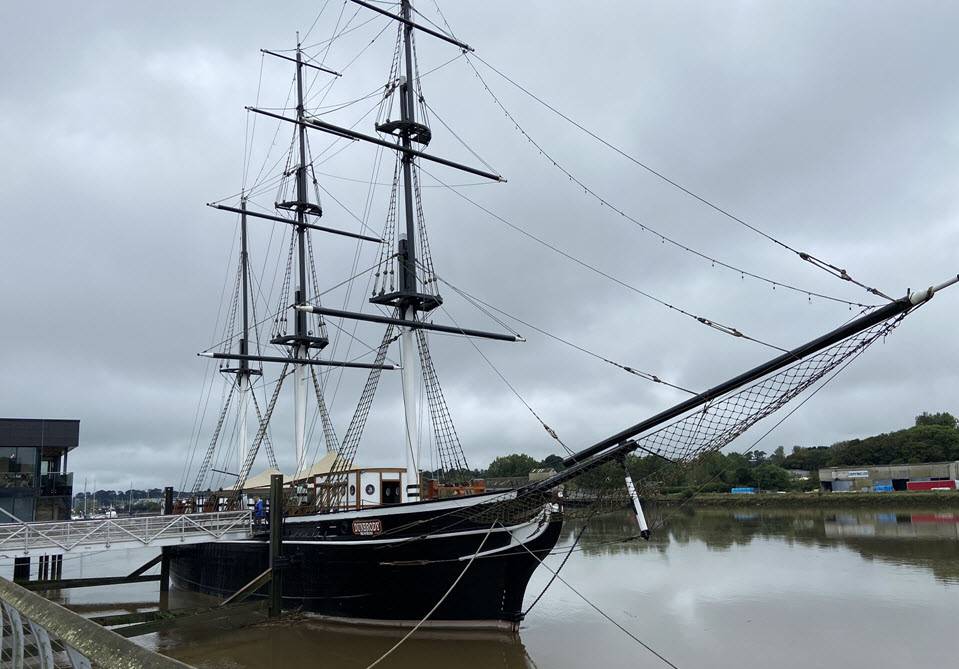
All who read William’s emigration story wish his account had been longer. What was it like to travel in steerage, what were the conditions, what did they have in provisions? We can can get a sense from a superb reproduction of an 1840s emigrant vessel, The Dunbrody, that is moored in New Ross, Co. Wexford, Ireland. Built in Quebec in 1845 the Dunbrody was a three-masted ship with a registered tonnage of 485.  Lloyd’s Register tells us that it was made of oak, elm, and “hamkmatack” – tamarack. Lloyd’s assessed the ship as A1. (1) In 1849, when it sailed for New York, it carried 176 passengers.

The Flemings sailed on the Jeanie Deans out of Glasgow – a three-masted barque in May 1843. It was 319 tons – a bit smaller than the Dunwoody, built in 1841, also in Quebec, and was “sheathed with yellow metal.” According to Lloyd’s Register, the ship was made from black birch, oak, and tamarack and graded as A1. (1) The Jeanie Deans carried 65 passengers and 10 crew on that voyage. (2)

Typically (as we learn from Cian T. McMahon’s book, The Coffin Ship), emigrant ships had a forecastle deck at the front, the main deck in the middle, and the poop at the rear. The poop deck was reserved for officers and ”cabin” passengers. Below the poop deck there might be a hospital and the ship’s galley. Steerage travellers were allowed on the main deck at designated times to cook their meals on an open-fire grate. For most of the day they were confined below the main deck – or ‘tween deck” – in a long room accessed through hatches from the deck. When the seas were rough, the hatches were nailed shut to prevent flooding, but this also closed off air and heightened the misery below deck. Sleeping and living arrangements were cramped.

Continue reading