A family history of the Flemings who came from Perthshire in 1843 to settle in Derby Township, Grey County. We follow the family into the mid 1900s as they dispersed across North America..
Jean Agnew (1862–1950) and her cousin Robert Fleming (1860–1894) were the first two of the Fleming families in Kilsyth to emigrate to the United States. Over the fifty-year period 1880 to 1930, 22 of Alexander Fleming and Jean Stewart’s 70 grandchildren (33%) left Derby Township to try life across the border. All but four stayed in the USA. The female Flemings were as adventurous as the male – a 50/50 split. Most were between the ages of 20 to 40. (1)
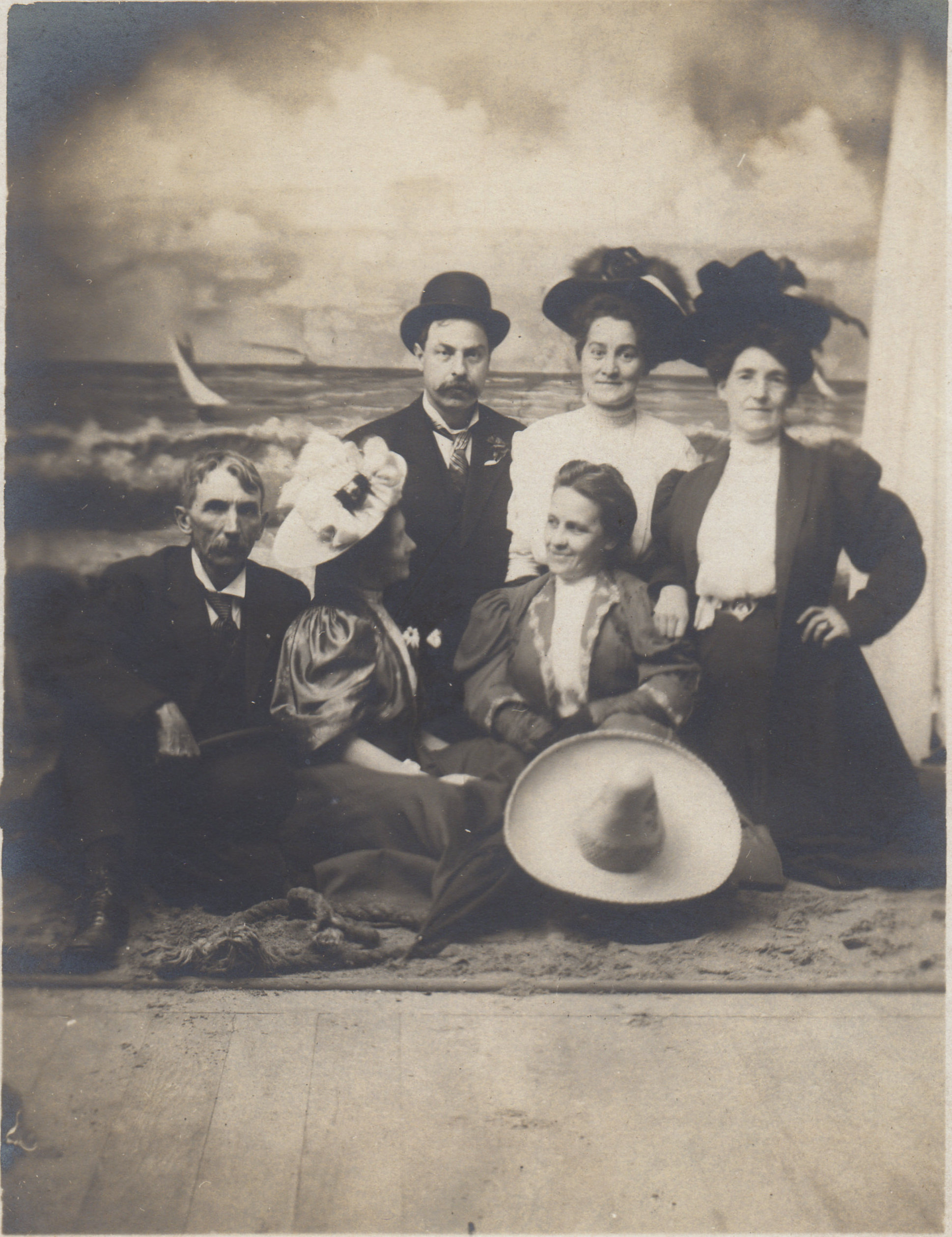
Outing to Ocean Park, CA. Bottom left, Minerva Fleming talking to Christina Fleming. Jean [Walmsley] on the far right. The woman behind Christina might be Jean Agnew. The men, Messrs Watson and Dury were friends of the Walmsleys. c. 1910 (Source: Fleming Family Photos)
The United States was a magnate for young people seeking better prospects for education, employment and income. The late 1860s to 1896 was the Gilded Age of rapid economic growth, technological invention, and industrial production. Hydroelectricity powered new factories. Cities in the East attracted new immigrants, and the West offered land and gold. Toronto, in 1891, with a population of 181,000, was small compared to the closest U.S. cities: Buffalo at 254,000, Detroit at 205,000, and Philadelphia at over one million.
Teacher, artist, photographer, historian, researcher— of these pursuits Roy may have loved the study of history the most.
Born in Kilsyth, Derby Township, in 1878, son of Charles Fleming and grandson of Alexander Fleming, Roy Franklin Fleming (1878-1958) had deep roots in Grey County where the Fleming family were pioneering settlers in the 1850s. He was almost destined to become an educationist— a specialist in education as he described himself— due to the Fleming family’s attention to education.
After formative years in the Normal School system in Ontario and several teaching assignments, Roy enrolled in the New York School of Art in 1905. Two years later (1907) he was appointed drawing master at the Ottawa Model School (later Ottawa Normal School). For many, this might have been sufficient, but Roy’s intense interest in the history of Ontario and especially in the Great Lakes and the indigenous people led him into many other endeavours.
His love of history began with a childhood filled with stories about the Scottish homeland and the emigration to Canada. As a young teacher in Sheguiandah, Manitoulin Island in 1899, his curiosity about local history and native peoples deepened as he came to know the Assiginack family—Blackbird in English. In the years following he undertook further research to write about the oratorical skills and military genius of Sahgimah and Assiginack and bring recognition to both.
In January 1935 TheDaily Sun Times published his long article—“Ottawas Defeated Invading Mohawks at Blue Mountain”—with the lengthy subtitle “Contingent of Warriors from Owen Sound, Saugeen, and Meaford Indian Villages Aided Ottawas and Objibways (sic) of Manitoulin Island Massacre Invading Iroquois —Chief Sahgimah Led Indians of This District in Bloody Battle.” (1)
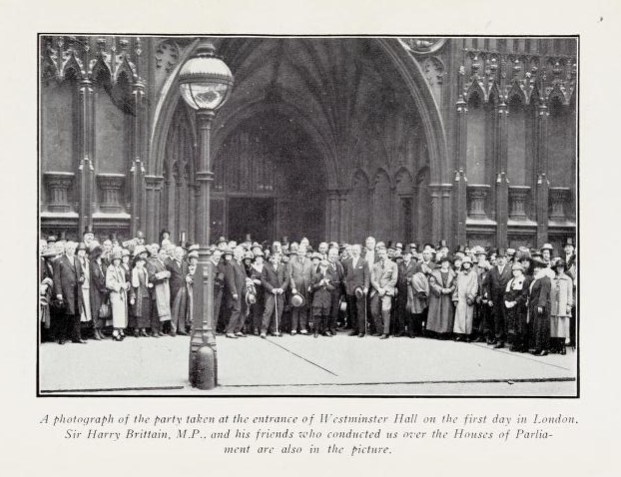
Canadian News Editors at Entrance to Westminster Hall, June 1924. Photo from Pilgrims of the Press.
At long last, Christopher Alexander (C.A.) Fleming, educator and publisher in Owen Sound, Ontario, was embarking on a voyage to the United Kingdom. The year was 1924 when Europe was rebuilding after the war of 1914-18. Roy Fleming, his cousin, had emphatically recommended such a trip after his own in 1903.
C.A. – you know you are rich – you might cease from your labors for two months and take a trip to the Old Country and see these places – see that land of true beauty and sweet traditions – the land of your fathers, which age will never dim. [Letter dated 14 October 1903]
Arranged by the Canadian Weekly Press Association for editors of weekly newspapers, the tour covered Belgium, Paris, and the major cities in the United Kingdom. There were 171 individuals in the party, of whom 101 were associated with some 100 weekly Canadian newspapers. Of these editors, 83 were men and 18 women. Seventy family members travelled with them. Many of the editors were from Ontario, and smaller numbers from the Atlantic provinces and the West. [Davies, “Who’s Who”]
C.A. owned the Daily Sun-Times and the weekly Cornwall Freeholder. His eldest daughter, Lillian, who was 37 and a kindergarten teacher, accompanied him on a trip that became the highlight of her life – especially the garden party at Buckingham Palace.
Over the eight weeks, C.A. mailed letters to the Daily Sun-Times with reports on the social events and the places – the streets, the people, the exhibits and tours. These were dense with descriptions of the farmlands and industrial sites and attentive to points that his Grey County readers would appreciate. He later published his reports as a collection in Letters from Europe.
W. Rupert Davies, of The Renfrew Mercury in Renfrew, Ontario, and former president of the Association, organized the itinerary and meetings with dignitaries and press associations. He published his account in Pilgrims of the Press, in which he explained that this endeavor was to be “an educational tour with the idea, not only of establishing a closer relationship between the weekly editors of Canada and the newspaper fraternity of the Old Land, but in order that we should all get first-hand knowledge of the Mother Country and some of its problems.” [Davies, p. 3] (Davies, who many years later was appointed to the Canadian Senate, brought his wife Florence McKay and their son Robertson – the Robertson Davies who grew up to be a journalist and acclaimed novelist.)
The idea for conducting such an ambitious tour was rooted in a strong sentiment for the British Empire. The elite of the Empire Press Union and the Newspaper Society in England provided full support and likely direction. We might surmise that their motives were to strengthen diplomatic and economic bonds between Canada and Britain. Notwithstanding that Canada had just fought for “King and Country,” Canadians were pressing instead for autonomy and independence from imperial requests.
George Herbert Wyllie, son of Mary Fleming and George Wyllie of Kilsyth, ON, was another young man of Fleming blood to join the Canadian Expeditionary Force during the Great War.
Fit, 5 feet 7 ¾ inches tall, 146 pounds, with blue eyes and fair hair, this strapping lad whose only blemish was a scar of three inches on the inner side of his left knee, walked into the Owen Sound recruitment office for the 147th Grey Overseas Battalion. The day was the 13th of May, 1916, four months to the day since he had turned 18 (on 14 January). Under the command of Lt. Col. G.F. McFarland, this battalion recruited 1,000 men during the winter of 1915-1916 and trained at Niagara-on-the-Lake and Camp Borden that summer. On November 14, 1916, Pte G. Herbert Wyllie, No. 839119, shipped out from Halifax on the RMS.Olympic.
RMS Olympic as a troopship during First World War, WikiMedia Commons
Through the CEF Personnel Records and the War Diaries at Library and Archives Canada we have learned more about Herb’s service and experience. Continue reading →
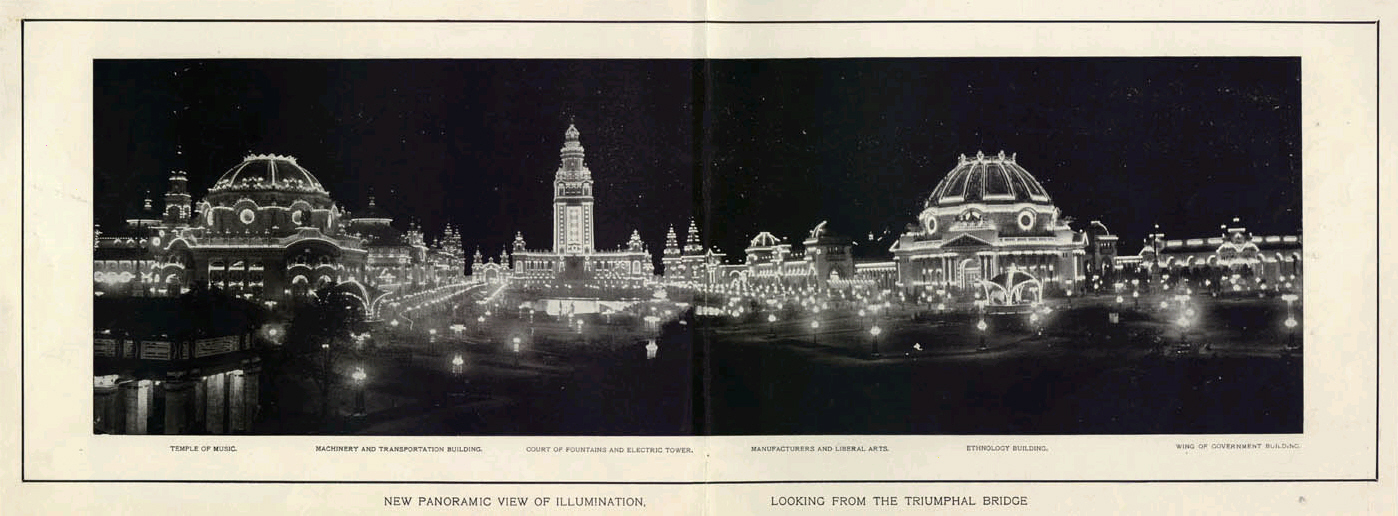
Panoramic View of the Pan-Am Exposition of 1901 in Buffalo. NY. Source Wikimedia (1)
Several members of the Fleming family moved to cities in New York State in the late 1800s. Researching their movements and lives has led us to the trove of the New York Heritage digital collections (https://nyheritage.org/) created by eight members of the Empire State Library Network.
Two cousins – Jean Agnew, daughter of Jessie (Fleming) Agnew, and Margaret Fleming, daughter of James Fleming – were among the first to enter new nursing programs being started in New York State in the 1880s.
Jean Agnew arrived in Rochester NY to begin her training at the Rochester City General Hospital around 1887. The Rochester City Hospital School of Nursing, the third nursing school in New York State, opened its doors in 1880. Continue reading →

 The Flemings of Derby Township