C.A. Fleming and the Sectional Boat

photo of four men carrying three parts of a sectional boat built by C.A. Fleming   he and fellow hunters used in the Algoma district in the early 1900s.
Carrying a sectional boat – 1914 – Rod and Gun in Canada

While researching the life of C.A. (Christopher Alexander) Fleming (1857-1945) for the Flemings of Derby Township: A family history, I learned that C.A. had designed and built a boat that could be separated into parts for easier travelling on hunting trips. (1) But I had no further information on shape or size or even usefulness. By good fortune, I came upon an article that C.A. wrote in 1914 describing the boat and wondered if this type of boat is made today.

C.A. Fleming, educator, publisher and banker in Owen Sound, Ontario, was at heart a “master hobbyist,” as we know from his biographer, Dorothea Deans. She drew attention to C.A.’s skills with all tools,  adeptness with machinery, and early adoption of camera and radio. “He had the inventiveness of a pioneer,” she wrote. (2)

He was also an avid outdoorsman, travelling into remote areas for hunting with the Striker Club in the late 1800s and early 1900s. My surprise was to find the article he wrote in 1914 in Rod and Gun in Canada in the Internet Archive.

Modestly, he explained in the opening paragraph: “The writer began experimenting about two years ago on boats that could be easily made by any handyman, that were light and tight, easily transported by train or vehicle, easily portaged, stored in a small space, and quite safe for any inexperienced person to handle.; and succeeded in building one that filled the conditions aimed at.” (3)

In the article, C.A. gave detailed instructions and parts lists for constructing a 13-foot-7-inch boat with a 42-inch beam weighing about 90 lbs. It could also serve as a motorboat with the addition of the Waterman outboard motor.

C.A. claimed that taking the boat apart was nearly dead simple: “… [I]t was very little trouble to take apart —we had only to take out eight bolts and separate it into three sections. We found no trouble in carrying it back two miles through the bush to a lake where the deer were taking to the water. The portable boat and the portable engine made a fine combination for the hunting grounds.” Being in segments, the boat, he found, was easy to load onto a train, could be packed with camping goods, and could be carried in portages.

Continue reading
A Trip of a Lifetime

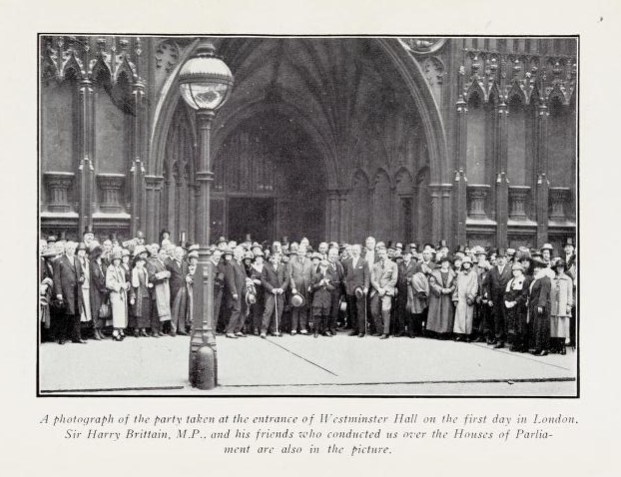
Canadian News Editors Party at Entrance to Westminster Hall, June 1924. Photo from Pilgrims of the Press.
Canadian News Editors at Entrance to Westminster Hall, June 1924. Photo from Pilgrims of the Press.

At long last, Christopher Alexander (C.A.) Fleming, educator and publisher in Owen Sound,  Ontario, was embarking on a voyage to the United Kingdom. The year was 1924 when Europe was rebuilding after the war of 1914-18.  Roy Fleming, his cousin, had emphatically recommended such a trip after his own in 1903.

C.A. – you know you are rich – you might cease from your labors for two months and take a trip to the Old Country and see these places – see that land of true beauty and sweet traditions – the land of your fathers,  which age will never dim. [Letter  dated  14 October 1903]

Arranged by the Canadian Weekly Press Association for editors of weekly newspapers, the tour covered Belgium, Paris, and the major cities in the United Kingdom.  There were 171 individuals in the party, of whom 101 were associated with some 100 weekly Canadian newspapers. Of these editors, 83 were men and 18 women. Seventy family members travelled with them. Many of the editors were from Ontario, and smaller numbers from the Atlantic provinces and the West. [Davies, “Who’s Who”]  

C.A. owned  the Daily Sun-Times and the weekly Cornwall Freeholder. His eldest daughter, Lillian, who was 37 and a kindergarten teacher, accompanied him on a trip that became the highlight of her life – especially the garden party at Buckingham Palace.

Over the eight weeks, C.A. mailed letters to the Daily Sun-Times with reports on the social events and the places – the streets, the people, the exhibits and tours. These were dense with descriptions of the farmlands and industrial sites and attentive to points that his Grey County readers would appreciate. He later published his reports as a collection in  Letters from Europe.

W. Rupert Davies, of The Renfrew Mercury in Renfrew, Ontario, and former president of the Association, organized the itinerary and meetings with dignitaries and press associations. He published his account in Pilgrims of the Press, in which he explained that this endeavor was to be  “an educational tour with the idea, not only of establishing a closer relationship between the weekly editors of Canada and the newspaper fraternity of the Old Land, but in order that we should all get first-hand knowledge of the Mother Country and some of its problems.” [Davies, p. 3] (Davies, who many years later was appointed to the Canadian Senate, brought his wife Florence  McKay and their son Robertson – the Robertson Davies who grew up to be a journalist and acclaimed novelist.)

The idea for conducting such an ambitious tour was rooted in a strong sentiment for the British Empire. The elite of the Empire Press Union and the Newspaper Society in England provided full support and likely direction. We might surmise that their motives were to strengthen diplomatic and economic bonds between Canada and Britain. Notwithstanding that Canada had just fought for “King and Country,” Canadians were pressing instead for autonomy and independence from imperial requests.

Continue reading

Dorothea Deans: “Women’s Editor”

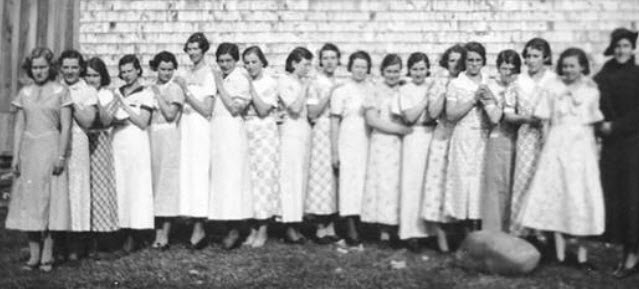
Group of Women at Bognor Hall. Date Unknown. Courtesy of The Grey Roots Archival Collection

We digress in this blog to shine a light on the woman who wrote the biography of  Christopher Alexander Fleming of Owen Sound, Ontario.  C.A. was a much loved and distinguished educator, auditor, and publisher in Grey and Bruce Counties.  After he died in April 1945, the Fleming family engaged Dorothea Deans to memorialize C.A.’s life and character. Dorothea, the women’s editor for the Sun Times in Owen Sound for over 20 years, was a perfect choice: She wrote well – her prose was warm, clear, and concise;  she had known C.A. thorough her work; and she had lived in that port city most of her life.

Family members would have provided Dorothea C.A.’s writings and correspondence, along with papers he and his cousin Roy Fleming had collected on family history. She must have interviewed many family members and business colleagues, and she could research many of his accomplishments in the newspapers.  In the first paragraph of the foreword, she laid out the scope of the work and nature of her subject carefully and reverentially.

This sketch of the life of Christopher Alexander Fleming is in no way an attempt at an interpretation of a man and his period. He is too close in time for that and too dear to family and friends to need translation. Rather, it is a record of facts about his hereditary background, his youth, and his long, productive years, gathered together like the photographs of an album, the acts of a play, the blueprints of a building. Somewhere, within the facts and the intangible things they imply, love and beauty, work and sacrifice, truth and aspiration, is the immortal personality. [1]

Continue reading

Finding historical texts and pictures

The richness of resources on local history – and that of Ontario in particular – constantly amazes me. Today I have two starting points to recommend: the University of Calgary’s digitzation project, and a list prepared by the Toronto Public Library of resources for finding photos.

Library and Cultural Resources Digital Collections at the University of Calgary (https://library.ucalgary.ca/digital) has a daunting number of collections – many about Alberta and some about the Arctic – even some about Japan. But the area of particular interest at present is Local Histories and Local Histories (2). Select one or both from the list and enter search terms for the subjects, people or places of interest.  The search interface provides guides to further filtering by date, subject and title.

Ourroots, the service that had digitized many Ontario historical texts, was taken over by the University of Calgary project and gradually all (or nearly all) texts have been remounted on new servers with the improved search interface. Two titles of great interest to us that are now available are: Continue reading