R.M.S. Tunisian – Montreal to Liverpool – June 27 to July 6, 1903

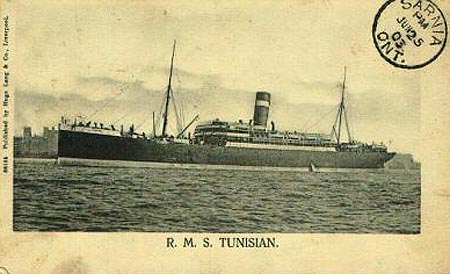
R.M.S. Tunisian - postcard postmarked Sarnia June 25, 2003
R.M.S. Tunisian – postcard 1903.  Courtesy Simplon Postcards, The Passenger Ship Website

Boarding in Montreal, the Fleming party settled into their quarters on the Tunisian at 7:30 pm Friday, June 26. Roy noted – “We put baggage in our rooms. Mine is Room 126 Berth 2, Uncle James 126-4. Aunt Jennie 128 – 2 – Minnie 128-4.” They were on the Upper Deck, in cabins on the outside wall. The Saloon Deck with the dining, music, and smoking saloons for second class and first class was above. The two top decks were the Bridge for First Class and the Promenade deck .

The Norway Heritage website has a full history of the Tunisian with postcards and the cabin floor plan.

With advances in steamer technology and ship design, travelling to Great Britain and the continent had become more comfortable and increasingly fashionable. They were travelling second (cabin) class in rooms that accommodated four people. Roy immediately remarked, “Rather neat appearance of rooms and dining rooms. Music Room and Smoking Room.”
Continue reading

Trip of a Lifetime: Introduction

jennie-fleming-1935-passport
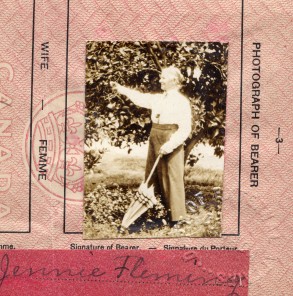
Jennie Fleming – Passport photo – c 1903

Nearly sixty years to the day that the Fleming family arrived in Quebec City from Glasgow, Scotland, Jennie Fleming, with her nephew Roy Fleming, her older brother James Fleming, and his daughter Minnie, boarded a steamer in Montreal bound for Liverpool, England.

Roy-Fleming-NewYork-1906-050.tif
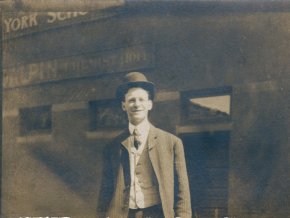
Roy Fleming in New York City, 1906

They were embarking on an eight-week trip through the British Isles and Europe that included a pilgrimage to their homeland in Perthshire. Roy had proposed the trip to his family in October of 1902 and they decided at Christmas. They must have been very busy over the next few months deciding on itinerary, arranging accommodations, and contacting family in Scotland.

It was Friday, June 26 1903. Their ship was the passenger liner R.M.S. Tunisian, built in 1900 for the Allan line. They were comfortably settled in two second-class cabins, the men in one with two other cabin mates, and the women in another across the passageway. James, who had been only a boy of thirteen when his parents Alexander and Jean emigrated from Perthshire Scotland with their children, must have remarked more than once on the luxury of the modern steamer with its dining saloons and decks compared to the cramped and harsh conditions of the Jeannie Deans, the wooden three-masted barque that had brought them to Canada.

Continue reading

Harvey Gladstone Fleming (Pte)

One more Fleming went to war. Harvey Gladstone Fleming, 21 years old, living in Kilsyth, Derby Township, responded to the Country’s now more fevered call for volunteer recruits.

He went even though he was a farmer. Farmers were usually discouraged from enlisting because of the importance of food production; and under the Military Service Act of 29 August 1917 they were exempt from conscription.   In

1914-18recruitmentitem28l
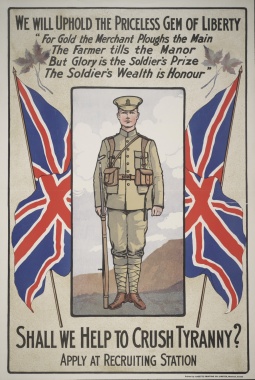
Recruitment Poster c 1916. Coutesy of Toronto Public Library

fact at Vimy in April 1917, only 6% of the men who fought were farmers; clerical workers made up 19% and manual workers 65%.(1)

Born 17 September 1895, Harvey was the son of John and Emma Fleming (John farmed 50 acres on Concession 9 Lot 11), and grandson of Alexander “Sandy” Fleming.

Like many other Fleming men he was of fair complexion, blue (or hazel) eyes, and light brown hair. He was a bit taller than others  at 5 feet 10 inches, weighing 145 pounds.

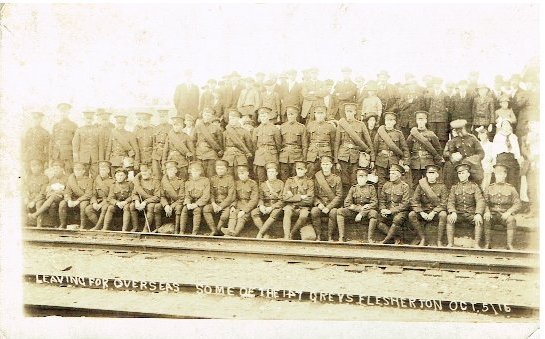
He was attested on 24 January 1917 into the 248th Grey Overseas Battalion.  By mid-1917 he was in England in the 8th Reserve Brigade. During training he was hospitalized for a mild case of mumps for two weeks (10-July-1917 to 1 August 1917).

Continue reading

George Donald (G.D.) Fleming (Maj)

147th-battalion-1916-002812106f
147th Battalion at Camp Borden, 1916. Courtesy South Grey Museum

Another Fleming to join the Canadian Expeditionary Force for World War 1 was George Donald (G.D.) Fleming, son of C.A. Fleming and Margaret Donald. When he left in 1916 as an officer in the 147th Grey Owen Sound Battalion, he was 27 years old, (born 22 October 1889), had a wife Alice Naomi Beaton, and a daughter “Peg” of 16 months.

He was a “secretary treasurer” by profession according to the attestation record – probably at the Northern Business College his father had founded in Owen Sound.

A man of medium height at 5 feet 9 inches, weighing 165 pounds, he had a fair complexion, blue eyes, and brown hair. George had been in the 31st Regiment militia for seven years. Feeling a very powerful loyalty to King and Country  and having seen his militia colleagues leave, he enlisted with the  76th Battalion 13 November 1915 (date of attestation)  for training at its Niagara Camp. He transferred to the  147th Grey Overseas Battalion 1 January 1916. Official papers show that he enlisted for overseas  service with the rank of Captain (3 February 1916).   It was the practice to direct troops from training into reserve battalions  in England and from there move men into a Division as needed. Continue reading

Fleming Descendants in World War One

poppy-pixabay-2754984_960_720As we pause to remember the 1917 on Remembrance Day 2017, this blog posting recognizes seven men in the Fleming Family Tree who were soldiers in the Canadian Expeditionary Force during World War 1. The digitization by Library and Archives Canada (LAC) of the Canadian Expeditionary Force (CEF) personnel service files and the War Diaries in which are recorded the daily events of the battalions give us access to a great deal of information. Four Fleming members fought in France and survived; three were very lucky and never saw action. No lives were lost. Continue reading