How Kilsyth Almost Got a Train Station

The 1850s was the decade of railway fever in Canada West. Every community from the tiniest hamlet campaigned to have a railway line – and the citizens of the Township of Derby were among them. We don’t know if the Flemings invested in railway bonds, but they must have followed the local Council meetings, and they eventually benefited from improved access to markets for their produce and greater ease of travel.
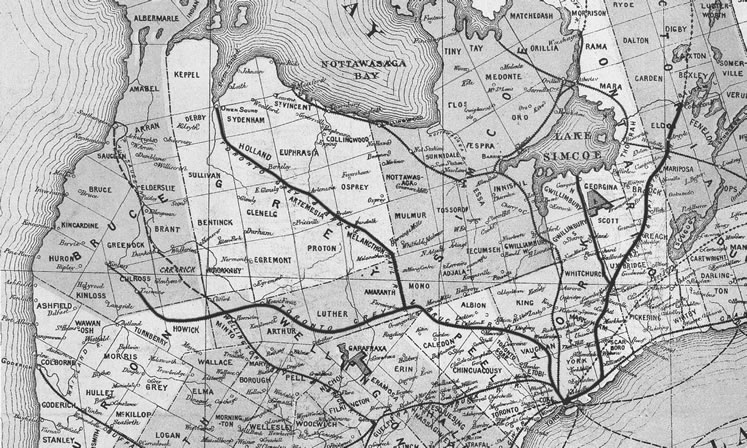
Image: The Toronto Grey and Bruce, Toronto and Nipissing, and Lake Simcoe Junction Railways 1877. Adapted by Rod Clarke from map of the Province of Ontario by James Campbell & Son of Toronto, 1874. The TG&BR extension from Teeswater to Kinloss was never built. Map also shows Northern Railway Toronto-Barrie-Collingwood-Meaford.

In the 1850s, railway building was booming. Over 2,000 miles of track were laid in the provinces of British North America. [i] By 1859 the Grand Trunk Railway ran from Quebec City, through Montreal and Toronto, to Sarnia, with extensions to Chicago, Illinois and Portland, Maine. Its rival, the Great Western, had lines from Niagara Falls to Windsor through Hamilton and London and connecting to Toronto.   The Northern Railway (previously the Toronto, Simcoe and Huron Railroad) reached Collingwood from Barrie in 1855.[ii] Jennie Fleming took this route for her trip to Toronto in 1869.[iii] But the great triangle of the Queen’s Bush along Lake Huron, the west half of Georgian Bay and south along the Garafraxa Road was unserved.   

Derby Township became involved with railway mania in July 1857 when Mr. Carney and Mr. W.A. Stephens came as a deputation from a railroad committee in Owen Sound – “to solicit a grant of money to aid in procuring the passing of the ByLaw for taking stock in the Toronto and Owen Sound Central Railway” (T&OSCR). Council was immediately enthusiastic and moved to set up a fund of 12 Pounds and 10 Shillings towards getting “sanction” from the ratepayers to buy ₤ 100,000. Further, Reeve Sam Jones and the Council expressed their thanks to the deputation “for affording them an opportunity of expressing their desire to see Railway communication afforded to the County of Grey and for honoring them with the first call for pecuniary assistance towards that object.” [iv]  The proposal, complete with routes, costs and benefits, and considerations, was documented by J.W. Tate in the Report on the proposed route of the Toronto and Owen Sound central railway.[v] The proposed route would run from Weston, up the Humber Valley to Mono Mills, across to Orangeville, north to Chatsworth and from there either along the Sydenham Valley through part of Derby Township or along another stream to the north of Owen Sound.[vi] 

Continue reading
The Legacy of Ancestors

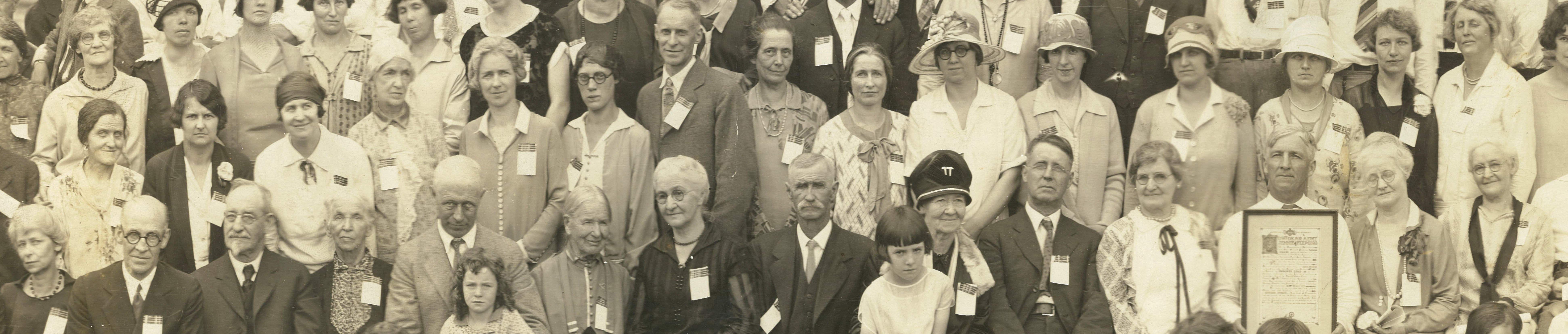
Excerpt from photograph of the 1927 Fleming Family Reunion in Kilsyth, ON
Excerpt from a photograph of the 1927 Fleming Family Reunion held at Springfield Farm, Kilsyth, ON. (Fleming Family Papers)

People have asked us: “why did you write a book about the Flemings of Derby Township?” Why did Ruth, a Fleming descendant with a trunk full of family records, and I, a friend who loves history, spend years compiling a four-inch thick book of stories, photographs and charts? One person remarked that family histories are mere vanity projects, suggesting, I submit, a poverty of outlook. There is much to be learned from past generations, as TV viewers of the PBS program Finding Your Roots know very well. Knowing the stories can be inspirational and motivational.

Some people have a memory store of recollections about their forebears – at least their grandparents and sometimes great-grandparents. Sadly, most do not and may barely know the stories of their parents’ lives. Deprived of stories about their families, children must make their lives without the grounding of knowing who they are — a loss of wisdom and understanding.

Indigenous peoples seem more attuned to ancestral knowledge — learning from the stories and traditions passed from generation to generation, how earlier generations survived their journeys and their times of deprivation, how they found spiritual connection and celebrated life.  

The Seventh Generation Principle from an ancient Haudenosaunee (Iroquois) philosophy holds that to be a good ancestor, people should look forward seven generations to make decisions that will benefit their descendants. Looking back seven generations, we can ponder the legacy brought about by the actions of our ancestors.  [https://www.ictinc.ca/blog/seventh-generation-principle ]

The answers for the Flemings are evident in the family history. In 1843, Alexander and Jean left their ancestral home in Perthshire for the wilderness of Upper Canada. After seven years of preparation, they were ready for the voyage. The first years were hard: they were in their early forties, trans-Atlantic crossings were perilous, and pioneer life was harsh. But with vision and resoluteness, they and their nine children succeeded, bequeathing customs, values and opportunities to their descendants.

We wrote the book to tell this story through four generations — as a legacy of knowledge and learning. Distribution to family members who had pre-ordered (about 150) took place in December 2022.

The book is also available at Ginger Press in Owen Sound at $85 CDN plus tax. Use the Contact Page at Ginger Press to inquire about ordering or contact me by leaving a comment to this blog post.

Continue reading