Trip of a Lifetime: Introduction

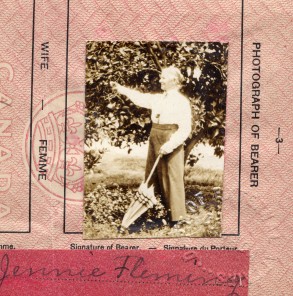
jennie-fleming-1935-passport
Jennie Fleming – Passport photo – c 1903

Nearly sixty years to the day that the Fleming family arrived in Quebec City from Glasgow, Scotland, Jennie Fleming, with her nephew Roy Fleming, her older brother James Fleming, and his daughter Minnie, boarded a steamer in Montreal bound for Liverpool, England.
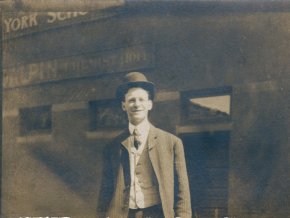
Roy-Fleming-NewYork-1906-050.tif
Roy Fleming in New York City, 1906

They were embarking on an eight-week trip through the British Isles and Europe that included a pilgrimage to their homeland in Perthshire. Roy had proposed the trip to his family in October of 1902 and they decided at Christmas. They must have been very busy over the next few months deciding on itinerary, arranging accommodations, and contacting family in Scotland.

It was Friday, June 26 1903. Their ship was the passenger liner R.M.S. Tunisian, built in 1900 for the Allan line. They were comfortably settled in two second-class cabins, the men in one with two other cabin mates, and the women in another across the passageway. James, who had been only a boy of thirteen when his parents Alexander and Jean emigrated from Perthshire Scotland with their children, must have remarked more than once on the luxury of the modern steamer with its dining saloons and decks compared to the cramped and harsh conditions of the Jeannie Deans, the wooden three-masted barque that had brought them to Canada.
Continue reading

Something Different

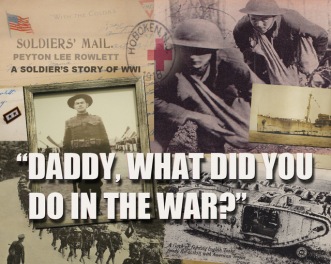
What if we could tell a family story through a mix of media, constructing a narrative arc with text, pictures, voice, video, and suspense; as well as one that involves family members? This is what has been accomplished in “Daddy, what did you do in the war?” A Soldier’s Story of WWI – a film (at YouTube) written and produced by Martha Rowlett about her father, a farm boy in Virginia who was drafted into the USA army during World War One.

ROWLETT FILM THUMBNAIL YOUTUBE A

The author crafted the script from letters Peyton Lee Rowlett wrote to his family, employed official war records, and blended in background information about the United States and its war effort in the years 1917-1918. Two young people from the current generation are the voices for the earlier generations. Continue reading

The Emigrant Woman in the 1850s

The Female Emigrant's Guide: Cooking with a Canadian Classic
Cover for The Female Emigrant’s Guide: Cooking with a Canadian Classic

To consider pioneer living in Derby Township in the 1850s and 1860 from the point of view of Jean Stewart Fleming and her daughters, there may be no better resource than Catherine Parr Traill’s The Female Emigrant’s Guide published in 1855. Traill wrote this guide explicitly to help women manage the difficult and unfamiliar conditions in Canada West in order to procure, harvest, and prepare foods for their families whether living deep in the bush or on a cleared farm. From her experience during her first  twenty years in Canada , Traill could advise women on everything from salting pork, storing potatoes, making  dandelion coffee, or furnishing a log cabin.

Titled Catharine Parr Traill’s The Female Emigrant’s Guide. Cooking with a Canadian Classic, this edition of 2017 from McGill Queen’s University Press was edited by  Nathalie Cooke and Fiona Lucas, both with academic and culinary credentials.   It includes the 1854 first edition of Traill’s guide with explanatory notes, and an equally sized supplement providing background and explanation of the “foodways of the period”.  The editors expand on Traill’s life and writings to describe the foods, availability of supplies, type of menus, measuring practices and tools, and much else to help the reader in the 21st century have a greater appreciation of the period.  Moreover, the editors help the curious prepare historical recipes adapted to current materials and cooking arrangements.

Catharine Parr Traill’s general guidance on life and housekeeping in Canada West and her carefully written instructions on food stuffs and preparation show us how extremely capable pioneer women had to be to feed their families and survive themselves.

“The pioneer’ wife’s knowledge and capabilities had to extend far beyond the home, the kitchen and the promotion of gracious and thrifty living – ideally, she must also be competent in the garden, in the fields, with the animals, as nurse and mid-wife, as manufacturer of clothing, and in emergencies, she must have hands as strong and head as clear as a man’s”. [Quoted from Clara Thomas, “Happily Ever After”.  (Pg xxvii)]

Traill provides practical advice on clearing the land – underbrush in the fall, and chop large timber in the winter, then pile appropriately to burn well. This advice she obtained from her brother Sam Strickland, and included in her book so that women, on whom so much fell, would know too. (p. 49)

Continue reading