Laird of Cragganfearn

Cragganfearn, Logierait Parish, Scotland in 2018. Photo by Eddie Thomson
Cragganfearn, Logierait Parish, Scotland in 2018. Photo by Eddie Thomson (https://www.heartlandtours.co.uk/)

Many families have a story from the past that takes on mythic qualities in the retelling. In genealogy, however, it is important to examine the story critically and evaluate the evidence. (1)

The Fleming family’s story has been about the “laird of Cragganfearn”,  the belief that Alexander Fleming’s grandfather had been “laird of Cragganfearn”, an estate of some 260 acres in the central part of the Atholl region of Perthshire. As the story goes, Alexander Fleming’s father, John, met his future wife Janet Ross at Cragganfearn where she was a servant. John’s father, the laird, banned the marriage and disinherited his son when John disobeyed. Very romantic, but how much is true? To be a laird means owning a substantial estate. Did a Fleming own that estate?

Others have wondered. In 2006 there was a heated thread at Rootschat in which three Fleming descendants sought information about the laird. One respondent (not a descendant) with the handle Tickle pointed out that the entire area had been owned by the Duke of Atholl in the 1700s, and that rental records at the Blair Estate in Blair Atholl (north of Logierait and Cragganfearn) would have the answer.

We examine the sources of this story, the information itself, and the evidence from land records and other accounts. We will see that the “lairdship” story began as wishful thinkin and continued thus. Continue reading
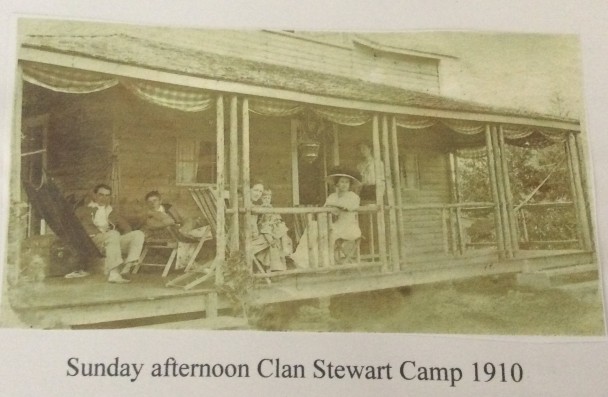
Clan Stewart Camp

Flemings-Camp-CSC-cropped

During the 1900s the Fleming family formed a deep and abiding love for the Fishing Islands at Oliphant, on the Lake Huron side of the Bruce Peninsula.  Attracted by the rugged nature of the islands, the abundant fishing, and the beautiful blue waters, they established camps in the very early 1900s on Main Station, Little Squaw, Sunset, Frog, and others.  Clan Stewart Camp on Little Squaw continues as a family gathering place. Roy Fleming, Ruth Larmour’s grandfather, and Roy’s Aunt Jennie bought this parcel of land in 1909 on Indian Channel and built a Victorian cottage.  They named their cottage Clan Stewart Camp after Jennie’s mother, Jean Stewart Fleming. The cottage has been modified a few times since, but its porch is still a favourite place for lounging in the afternoon.

The story of the early Fleming campers, their descendants, and of Clan Stewart Camp is told in “The Fleming Family – Early Oliphant Campers'” published in the Yearbook Edition 2017 of the Bruce County Historical Society.  Ruth Larmour is the narrator  with tales of early cottage life, the changing connections of family with the islands, and her own deep attachment.

Read the full article at  Fleming-Oliphant-Version3a-2017.pdf (in Dropbox)


A River Runs Through It

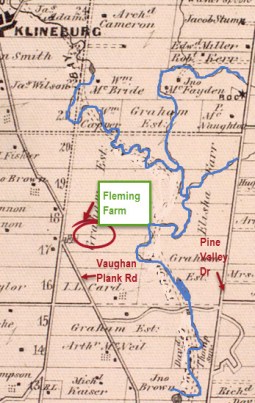
The Flemings ,on arriving in Canada West from Perthshire in June 1843, settled first in Vaughan Township, about twenty miles north of Toronto.  Alexander arranged to lease land from William Richard Grahame who had bought 1200 Acres  in 1833 from the Canada Company along the east branch of the Humber between Pinegrove and Kleinburg.  Under the agreement, Alexander was  to clear fifty acres in Concession 7 in an area straddling lots 17 and 18, pay Grahame $ 5 an acre, and retain rest of proceeds from their produce. Over the next six years they built a shelter, erected a barn, raised livestock, cleared the acres, and grew crops. Through hard work and determination, they were able to buy their own 200 acres in the newly surveyed Derby Township and move there in 1850.

map-vaughan-small
Section of Vaughan Township – adapted from 1878 York County  Atlas

The story of their years in Vaughan  is part of family legend.  Roy, Alexander’s grandson, made more than one trip to the area in the 1930s to try to locate the exact area of the farm.  His aunt Jennie recalled some landmarks but finding the farm eluded them.  In October 2016 three descendants and I tried: Ruth Larmour, Roy’s granddaughter, Janet McNally, descendant of James Fleming, and Carol Danard, descendent of Isabella Fleming Finch.

We knew that Lots 17 and 18 would be roughly half way north from Rutherford Road to Major Mackenzie Drive, and that the farm should be east of the East Humber River and just west of Islington Avenue.   The William Granger Greenway passes through this area of the flood plain of the East Humber.

Our clues were: Continue reading