Birth, Marriages, and Deaths

Much can be learned from the announcements in newspapers for births, marriages, and deaths. For  marriages, in addition to the names of married couple, the  location, and name of the presiding minister,  the notice might mention the number of guests and names of attendants.  Birth notices were much less informative – limited in most cases to the father’s name, the date, and the gender.  Obituaries vary widely, from a sparse  statement of  name, date, place, to more effusive ones with a brief biography and names of immediate family.

For the Fleming families of Derby Township and Owen Sound we turn to the papers published in Owen Sound from 1850 onward.  Thankfully, the Bruce and Grey Branch Ontario Genealogy Society has transcribed these announcements to CD ROMs that may be purchased from the branch or may be viewed at the Toronto Public Library, the Owen Sound Public Library, and perhaps others.  [Price list: https://brucegrey.ogs.on.ca/?page_id=62 ] Continue reading
Derby Township Assessment Rolls

In investigating the lives of our ancestors much can be inferred from the tax assessment rolls.  In researching the Flemings of Derby Township we can see  acquisition of acreage, clearance of forests for pasture and crops, and the growing value in real property. Five of Alexander’s sons (James, John, Alexander II, Donald, and Charles), and his son-in-law (James Agnew)  became established as farmers. William, the sixth son, left his farm and moved to Owen Sound in the early 1880s.

Assessment rolls were completed annually by the township in order to determine taxes payable by its residents.

Assessment rolls are used to record information about a resident’s property in order to determine the amount of taxes payable on real property.  The following information is recorded: land and building value; status as residence or business, religion (for school taxation purposes), age, and occupation of head of household and number of people living on the property.  Other information is collected from time to time reflecting local or provincial requirements. [Source: Finding Municipal Record, Research Guide 209, Archives of Ontario]

Continue reading

Diary of Young Roy

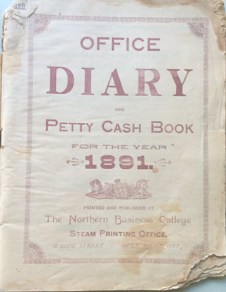
Among the Fleming family papers is a diary that Roy F. Fleming, son of Charles and Lyda Warren, kept in 1891 when he was a boy of twelve living on a farm near Kilsyth in Derby Township.  It was a sad and tumultuous year for him and the Fleming family. The greatest tragedy was that his mother died  in March while receiving treatment at the Kellogg Sanatorium in Battle Creek, Michigan. Roy with his two older brothers, Howard and Stuart, and two younger sisters, Ruth and Annie,  carried on working with their father on the farm and in his general store, going to school and to church. Charles’ sister “Aunt Jennie” stepped in to help raise the young children.

office-diary-1891-sm
Front page of Roy Fleming’s 1891 Diary

Roy recorded his diary in a journal printed by  C.A. Fleming,  Roy’s cousin, for the Northern Business College, Owen Sound. Continue reading

From Petition to Patent

Obtaining land from the Crown in Upper Canada began with a written petition to the Crown stating who you were and what you sought, and culminated in receiving the patent (as the deed was called) to the land.

In the summer of 1847 Alexander Fleming with his son James walked from Vaughan, near Toronto, north to the newly opened Derby Township in Grey County. Their purpose was to examine available lots and make a selection. Alexander likely submitted a petition to request Lots 9 and 10 in the 6th Concession, and , after paying the ₤ 157.12, received patents for the land 23 November 1847. We know from a copy of the receipt kept by the family that most of the payment was made in script, a type of voucher given to soldiers that could be redeemed for land or traded to others for money.

His next recorded purchase was Lot 6 Concession 9 in 1858, but we learn from papers Continue reading

A River Runs Through It

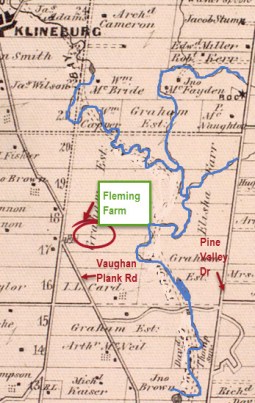
The Flemings ,on arriving in Canada West from Perthshire in June 1843, settled first in Vaughan Township, about twenty miles north of Toronto.  Alexander arranged to lease land from William Richard Grahame who had bought 1200 Acres  in 1833 from the Canada Company along the east branch of the Humber between Pinegrove and Kleinburg.  Under the agreement, Alexander was  to clear fifty acres in Concession 7 in an area straddling lots 17 and 18, pay Grahame $ 5 an acre, and retain rest of proceeds from their produce. Over the next six years they built a shelter, erected a barn, raised livestock, cleared the acres, and grew crops. Through hard work and determination, they were able to buy their own 200 acres in the newly surveyed Derby Township and move there in 1850.

map-vaughan-small
Section of Vaughan Township – adapted from 1878 York County  Atlas

The story of their years in Vaughan  is part of family legend.  Roy, Alexander’s grandson, made more than one trip to the area in the 1930s to try to locate the exact area of the farm.  His aunt Jennie recalled some landmarks but finding the farm eluded them.  In October 2016 three descendants and I tried: Ruth Larmour, Roy’s granddaughter, Janet McNally, descendant of James Fleming, and Carol Danard, descendent of Isabella Fleming Finch.

We knew that Lots 17 and 18 would be roughly half way north from Rutherford Road to Major Mackenzie Drive, and that the farm should be east of the East Humber River and just west of Islington Avenue.   The William Granger Greenway passes through this area of the flood plain of the East Humber.

Our clues were: Continue reading