All Hallow’s Eve, A Celtic Tradition

Did the Fleming families, who settled near Kilsyth, Derby Township, in the mid-1800s, partake in the Scottish tradition of All Hallow’s Eve?  Hard to know.  There is no mention of Halloween in family papers. As Disciples of Christ, they would have disapproved of pagan practices of ghouls and ghosts and the connection to the occult. But they may have retained something of the “All Saints” day on November 1 to remember the departed faithful.

Modern day, inflated plastic pumpkin - lawn ornament. 2021
Inflated plastic, artificially lit pumpkin 2021

We may think of Halloween as a North American excuse for spooky lawn decorations, jack o’lantern competitions, and costume dress-up for children going from door to door to get candy.  But Halloween has been much more, with traditions of bonfires and spirits more frightening than the inflated, lit, plastic ghosts we see today.

Halloween has its origins in Samhain (pronounced SAH-wane), a Celtic festival at the end of October when the spirit world became visible. The celebration marked the end of harvest and the beginning of winter and was an occasion to commune with the Otherworld – when spirits and faeries and the souls of the dead mixed with the living. Big bonfires kept people safe from the visiting evil spirits. Lanterns were fashioned by hollowing out turnips, carving scary features, and placing a lit candle inside to cast light and safety.  Children, to hide from the spirits, would go “guising” in costumes undercover as the malicious ones. Adults might do the same.  A song or a trick or just knocking on a neighbour’s door might earn them a treat.  For a game, they might bob for apples. (1,2,3)

Robert Burns recognized Halloween in his poem of that name in 1785. The first verse (in English translation) caught the night’s excitement of moonlight and movement.

Continue reading
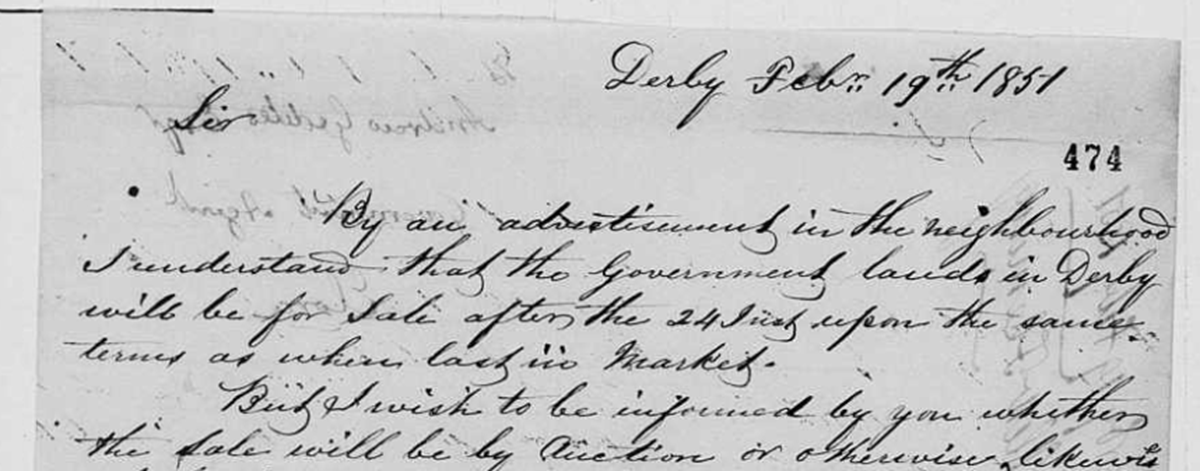
Ontario Township Papers ca 1783-1870

Announcements of newly digitized archival materials are always a pleasant surprise. In November 2020 genealogy blogs active in Ontario publicized that Family Search had loaded the Township Papers  ca 1783-1870 for the Province of Ontario held  on reels of  microfilm at the Archives of Ontario. These reels consist of a mélange of land-related documents not filed elsewhere. Archives of Ontario described  them as follows:

… copies of orders-in-council; copies of location certificates and location tickets; copies of assignments; certificates verifying the completion of settlement duties; copies of receipt; copies of descriptions; and copies of patents; and copies of incoming correspondence.

Township Papers – Archives of Ontario

My objective was to see what can be found about the Fleming families who pioneered in Derby Township, Grey County in the 1850s.

The papers are organized alphabetically by township.  Access at Family Search is through these two links.

We begin with Derby Township, identified on two lines on the image below. Click on the camera icon to view a gallery of images for the letters of that township organized by concession and lot.

UPDATE 12 April 2021 – I explored the Derby Township papers in late March. On preparing this blog post I found that townships from D to Haldimand had been dropped. This is probably a temporary glitch. Hopefully, your interest will be in one of the other townships.

Continue reading

A Trip of a Lifetime

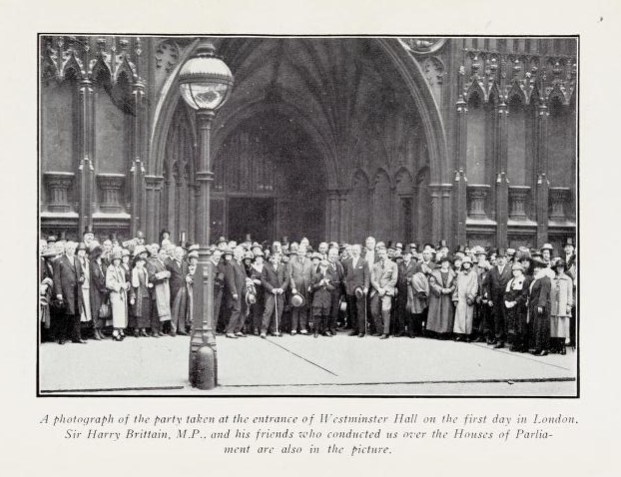
Canadian News Editors Party at Entrance to Westminster Hall, June 1924. Photo from Pilgrims of the Press.
Canadian News Editors at Entrance to Westminster Hall, June 1924. Photo from Pilgrims of the Press.

At long last, Christopher Alexander (C.A.) Fleming, educator and publisher in Owen Sound,  Ontario, was embarking on a voyage to the United Kingdom. The year was 1924 when Europe was rebuilding after the war of 1914-18.  Roy Fleming, his cousin, had emphatically recommended such a trip after his own in 1903.

C.A. – you know you are rich – you might cease from your labors for two months and take a trip to the Old Country and see these places – see that land of true beauty and sweet traditions – the land of your fathers,  which age will never dim. [Letter  dated  14 October 1903]

Arranged by the Canadian Weekly Press Association for editors of weekly newspapers, the tour covered Belgium, Paris, and the major cities in the United Kingdom.  There were 171 individuals in the party, of whom 101 were associated with some 100 weekly Canadian newspapers. Of these editors, 83 were men and 18 women. Seventy family members travelled with them. Many of the editors were from Ontario, and smaller numbers from the Atlantic provinces and the West. [Davies, “Who’s Who”]  

C.A. owned  the Daily Sun-Times and the weekly Cornwall Freeholder. His eldest daughter, Lillian, who was 37 and a kindergarten teacher, accompanied him on a trip that became the highlight of her life – especially the garden party at Buckingham Palace.

Over the eight weeks, C.A. mailed letters to the Daily Sun-Times with reports on the social events and the places – the streets, the people, the exhibits and tours. These were dense with descriptions of the farmlands and industrial sites and attentive to points that his Grey County readers would appreciate. He later published his reports as a collection in  Letters from Europe.

W. Rupert Davies, of The Renfrew Mercury in Renfrew, Ontario, and former president of the Association, organized the itinerary and meetings with dignitaries and press associations. He published his account in Pilgrims of the Press, in which he explained that this endeavor was to be  “an educational tour with the idea, not only of establishing a closer relationship between the weekly editors of Canada and the newspaper fraternity of the Old Land, but in order that we should all get first-hand knowledge of the Mother Country and some of its problems.” [Davies, p. 3] (Davies, who many years later was appointed to the Canadian Senate, brought his wife Florence  McKay and their son Robertson – the Robertson Davies who grew up to be a journalist and acclaimed novelist.)

The idea for conducting such an ambitious tour was rooted in a strong sentiment for the British Empire. The elite of the Empire Press Union and the Newspaper Society in England provided full support and likely direction. We might surmise that their motives were to strengthen diplomatic and economic bonds between Canada and Britain. Notwithstanding that Canada had just fought for “King and Country,” Canadians were pressing instead for autonomy and independence from imperial requests.

Continue reading

Dorothea Deans: “Women’s Editor”

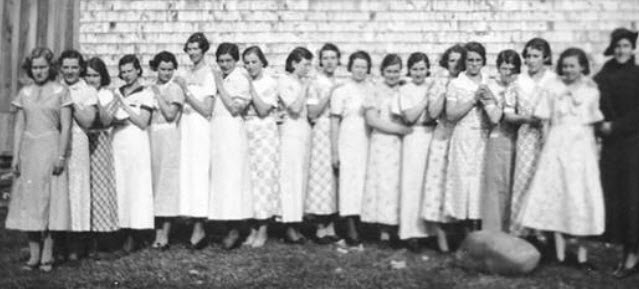
Group of Women at Bognor Hall. Date Unknown. Courtesy of The Grey Roots Archival Collection

We digress in this blog to shine a light on the woman who wrote the biography of  Christopher Alexander Fleming of Owen Sound, Ontario.  C.A. was a much loved and distinguished educator, auditor, and publisher in Grey and Bruce Counties.  After he died in April 1945, the Fleming family engaged Dorothea Deans to memorialize C.A.’s life and character. Dorothea, the women’s editor for the Sun Times in Owen Sound for over 20 years, was a perfect choice: She wrote well – her prose was warm, clear, and concise;  she had known C.A. thorough her work; and she had lived in that port city most of her life.

Family members would have provided Dorothea C.A.’s writings and correspondence, along with papers he and his cousin Roy Fleming had collected on family history. She must have interviewed many family members and business colleagues, and she could research many of his accomplishments in the newspapers.  In the first paragraph of the foreword, she laid out the scope of the work and nature of her subject carefully and reverentially.

This sketch of the life of Christopher Alexander Fleming is in no way an attempt at an interpretation of a man and his period. He is too close in time for that and too dear to family and friends to need translation. Rather, it is a record of facts about his hereditary background, his youth, and his long, productive years, gathered together like the photographs of an album, the acts of a play, the blueprints of a building. Somewhere, within the facts and the intangible things they imply, love and beauty, work and sacrifice, truth and aspiration, is the immortal personality. [1]

Continue reading

Researching Land Records in Ontario

Land records have been an important resource in documenting the history of the Fleming families in Derby Township, Grey County. The most useful record has been the “abstract index to deeds” adopted in the land record offices in 1865. The abstract is a summary of the transaction showing dates, instrument number, transaction type, lot and concession, acres, grantor and grantee, dollar amount. Transaction codes indicate “bargain and sale,” mortgage received, discharge of mortgage, release, grant, and other events. In a nutshell it shows the history of the changes in ownership and financing arrangements, and sometimes the disposal of an estate. For further detail, it was sometimes necessary to find the memorialization of the deed or transfer by the instrument number in the copybook for the township or locate the original document.

Previously, researchers had to go to the county land registry office or Archives of Ontario. Today the Ontario Land Registry Access (OnLand) website provides online access to digital images of the index pages. This posting is a short guide for searching that service.

Land records are organized by concession and lot. In our case, we knew the concession and lot numbers of the properties Alexander Fleming bought in 1847 and 1858. Another source for this information are farmers’ directories – especially the Gazetteer and Directory of the County of Grey  1865-6 (Toronto: W W Smith, 1865)

In this example, we are looking for the history of “Forest Lawn” on the north half of Lot 9 Concession 6. James Fleming obtained the lot from his father in 1853 and during his lifetime developed it into an estate of orchards and gardens. Continue reading