1931 Canada Census: Families Finch and Agnew

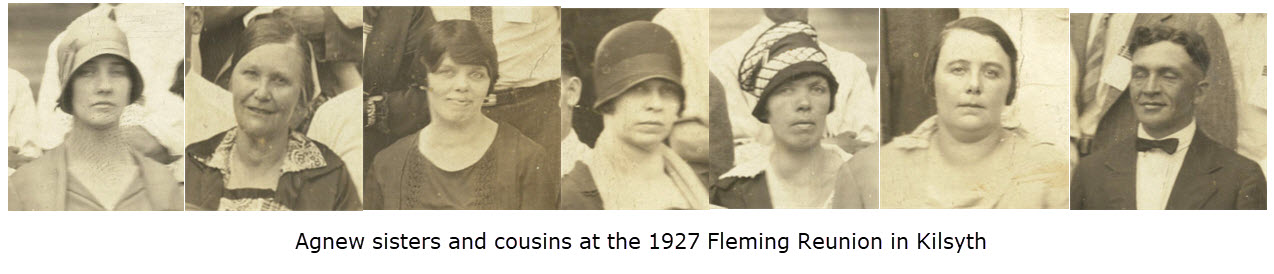
Excerpts from a photograph of the 1927 Fleming Reunion. These are descendants of Jessie (Fleming) Agnew.

In reviewing the lives of the descendants of Alexander Fleming and Jean Stewart, we begin with the families of their daughters: Isobel (1825-1917), married to Abraham Finch, and Janet (1828-1918), to James Agnew. They and several of their children had died before 1931, but we can see through the 1931 Census how the younger ones and their children were faring in the strained economic times of the early 1930s. Nearly all were far from Grey County in diverse occupations across the continent – only a couple were still farming. Several owned their houses, mostly made of wood, and some had radios.

The Finches

The effervescent Bella [Herald], who had moved to Ontario’s Parry Sound district, died in 1923. Her beloved adopted son William Herald, who had survived the battles in Europe,  settled in Parry Sound to work as a salesman in a general store and begin a family with Annie Lang.

Isobel’s daughter Jessie[Trout] was 80 years old in 1931 and widowed. She and her daughter Ella (Isabella) resided at 78 Dawson Street in Wiarton, where they shared an eight-room wood house valued at $1000. Ella was 57 and living on “income,” perhaps from savings from her years in Toronto as a public school teacher. There was no radio in their house.

Alexander Heneage Finch, a Disciple minister and Manitoba farmer, died in 1920. Widowed Sophie (de la Ree) lived in Winnipeg with her daughter’s family: Thomas Babb, Beatrice, and the four-year-old Reginald. The Babbs rented their five-room wood house on Ashburn Street, and they did have a radio.   Thomas taught, possibly at a high school.

Most of Sophie’s and Alexander’s children were alive in 1931, all but two residing in Alberta.

  • Horace, an insurance agent, had a house for his wife and two daughters in Wetaskiwin, AB., near Edmonton.
  • Bertram, a farmer in Minitonas in the Swan River region of Manitoba where he had grown up, worked for his father-in-law, John Smith.
  • Percival was a salesman for a lumber yard in Viking, AB. He, his wife and daughter, rented a wood house and were among the few with a radio.
  • Norman managed a lumber yard in Clyde AB, where he owned a four-room house for his wife and two daughters. They had a radio.  
  • Alexander was a carpenter in house-building in Mirror, AB. His small family also lived in a wooden house they owned. Alexander was currently out of work.  
  • Carlos “Carl” managed a retail lumber yard in Irma, AB. Single, he lodged with a family.
  • Cecil was not enumerated, but other records suggest Alberta or Manitoba.
  • Ruby Mae, married to Martin Danard, was probably living in Flin Flon, MB, where three children were born. The family was missed in the 1931 census.
  • James, at age 25, was in Winnipeg, married, and working as an electrician. He and Katherine rented a two-room apartment and had a radio.        

Isobel’s next son William died from influenza in Winnipeg in 1918. Several of his and Martha’s children lived in Winnipeg – Earnest, Robert, and Olive [Rhodes] are three who were enumerated. Others, though alive, were missed.
Continue reading

1931 Canada Census

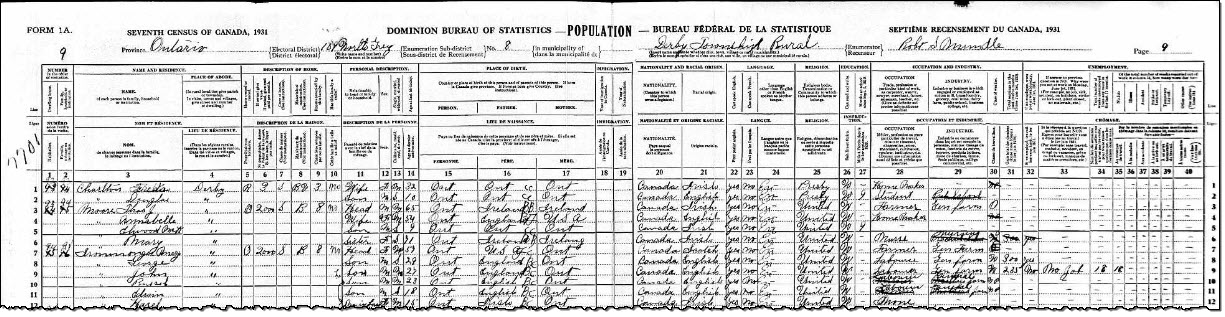
Excerpt from 1931 Canada Census – Schedule for Population – North Grey, Derby, Ontario

The event all genealogists in Canada have been waiting for has arrived: Library and Archives Canada released its digitization of 234,678 images of the 1931 Canada Census on June 1, 2023. The collection is open for browsing by location – province, district and sub-district. (1)   Eight days later, Ancestry, using its Handwriting Recognition software,  delivered  a searchable indexed database to subscribers. Family Search will soon follow with its index. Images may also be browsed by province and district at FindMyPast.

The enumerators recorded details on more than 10.3 million people. Canada’s population after the First World War had grown 18% from the 8.7 million of 1921. Many immigrants were from Europe, attracted to agriculture in the Prairie provinces. At the same time and especially in Ontario the urban population surpassed the rural as men and women left farms to work in factories and offices. Trouble appeared in the late 1920s with crop failures in the west and the stock market crash of 1929 in the east. By 1931 the Great Depression had taken hold with rising unemployment, homelessness and hunger. By 1933 unemployment was 33%. During this time, the Prairies were beset by drought and insects  to bring on the Dirty Thirties. Not all were devastated: property owners and people with jobs fared much better. These outcomes are captured in the data on house values, income, and employment. (2)

The Census provides a snapshot of how families were managing across the nation. Questions concerned housing, income, employment, ethnicity, nationality, education – and, very interestingly, possession of a radio.    

Continue reading

Derby Township Assessment Rolls

In investigating the lives of our ancestors much can be inferred from the tax assessment rolls.  In researching the Flemings of Derby Township we can see  acquisition of acreage, clearance of forests for pasture and crops, and the growing value in real property. Five of Alexander’s sons (James, John, Alexander II, Donald, and Charles), and his son-in-law (James Agnew)  became established as farmers. William, the sixth son, left his farm and moved to Owen Sound in the early 1880s.

Assessment rolls were completed annually by the township in order to determine taxes payable by its residents.

Assessment rolls are used to record information about a resident’s property in order to determine the amount of taxes payable on real property.  The following information is recorded: land and building value; status as residence or business, religion (for school taxation purposes), age, and occupation of head of household and number of people living on the property.  Other information is collected from time to time reflecting local or provincial requirements. [Source: Finding Municipal Record, Research Guide 209, Archives of Ontario]

Continue reading