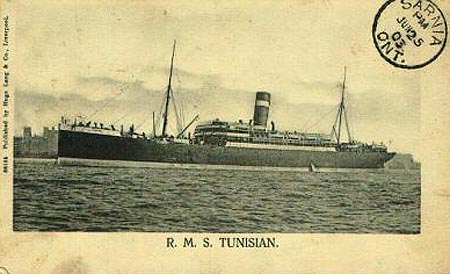
R.M.S. Tunisian – Montreal to Liverpool – June 27 to July 6, 1903

R.M.S. Tunisian - postcard postmarked Sarnia June 25, 2003
R.M.S. Tunisian – postcard 1903.  Courtesy Simplon Postcards, The Passenger Ship Website

Boarding in Montreal, the Fleming party settled into their quarters on the Tunisian at 7:30 pm Friday, June 26. Roy noted – “We put baggage in our rooms. Mine is Room 126 Berth 2, Uncle James 126-4. Aunt Jennie 128 – 2 – Minnie 128-4.” They were on the Upper Deck, in cabins on the outside wall. The Saloon Deck with the dining, music, and smoking saloons for second class and first class was above. The two top decks were the Bridge for First Class and the Promenade deck .

The Norway Heritage website has a full history of the Tunisian with postcards and the cabin floor plan.

With advances in steamer technology and ship design, travelling to Great Britain and the continent had become more comfortable and increasingly fashionable. They were travelling second (cabin) class in rooms that accommodated four people. Roy immediately remarked, “Rather neat appearance of rooms and dining rooms. Music Room and Smoking Room.”
Continue reading

Trip of a Lifetime: Introduction

jennie-fleming-1935-passport
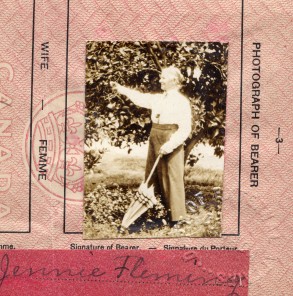
Jennie Fleming – Passport photo – c 1903

Nearly sixty years to the day that the Fleming family arrived in Quebec City from Glasgow, Scotland, Jennie Fleming, with her nephew Roy Fleming, her older brother James Fleming, and his daughter Minnie, boarded a steamer in Montreal bound for Liverpool, England.

Roy-Fleming-NewYork-1906-050.tif
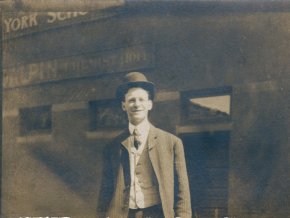
Roy Fleming in New York City, 1906

They were embarking on an eight-week trip through the British Isles and Europe that included a pilgrimage to their homeland in Perthshire. Roy had proposed the trip to his family in October of 1902 and they decided at Christmas. They must have been very busy over the next few months deciding on itinerary, arranging accommodations, and contacting family in Scotland.

It was Friday, June 26 1903. Their ship was the passenger liner R.M.S. Tunisian, built in 1900 for the Allan line. They were comfortably settled in two second-class cabins, the men in one with two other cabin mates, and the women in another across the passageway. James, who had been only a boy of thirteen when his parents Alexander and Jean emigrated from Perthshire Scotland with their children, must have remarked more than once on the luxury of the modern steamer with its dining saloons and decks compared to the cramped and harsh conditions of the Jeannie Deans, the wooden three-masted barque that had brought them to Canada.

Continue reading

Rural Diaries

Good news: The Rural Diary Archive, a project at the University of Guelph to showcase rural life in Ontario 1850 to 1900 through diaries, has added two Fleming diaries to its online collection. Many thanks to the Library and Department of History at the University of Guelph.

Jennie Fleming kept a diary of her trip by train to Toronto and Bowmanville in June 1869, and jotted some notes about her return voyage from Marquette, Michigan in 1871. Her profile page is at https://ruraldiaries.lib.uoguelph.ca/jean-jennie-fleming

Roy Fleming, her nephew, when only 12 years of age, kept a short entry diary throughout 1891, the year his mother died. It’s poignant and informative about rural living from a young person’s view.  https://ruraldiaries.lib.uoguelph.ca/roy-franklin-fleming

Scans of both diaries are available, as well as transcriptions of the content accompanied by explanatory notes.   Click on the Browse tab to locate the images and transcriptions.

More diaries  can be easily discovered by reviewing the list of diarists.   Filter by county, ethnicity, religion or occupation.

For Meaford in Grey County, Mary (Williams) Trout appears. Married to James Trout, a land agent in Trout and Jay and a prominent member of the Church of  Disciples of Christ, she also figures into Fleming Family history because her sister, Elizabeth, married William Fleming. Mary kept a diary from 1867 to 1920 about her family, the church, and activities. Occasionally  Mary mentions her sister “Lib”, children Lincoln and Ottie,  and trips to Owen Sound. The Rural Diary Archive has posted the 1867 diary. The complete set  of scans and transcriptions is online at the Grey Roots Museum and Archives site: Mary Williams Trout: Diaries of a small town lady.


Some Updates

We have not foresaken the family history.  Gradually we are making progress through the period 1850 to 1900 during which the Flemings of Derby built up their farms, founded new businesses, and raised their children.  This website will carry shorter versions of the family annals.  Two are available now. If you have more information about the Fleming family please comment on this blog to connect with Ruth Larmour. We thank those who have done so already.

  • Isabella Fleming and Abraham Finch : the family tree (chart) has been updated to fill in some blanks for life dates and children’s names.
  • Janet Fleming – or as she preferred to be called – Jessie, and James Agnew : Jessie’s biography with capsule accounts for the children is now available and the family tree has been updated for new findings.

The Fleming family tree is also being built out in Ancestry.ca and now has some photos.  This is a public tree for easier viewing – the  only challenge is to get the hang of Ancestry’s display.

A full biography of Roy F. Fleming, Charles’s son – a man of many talents and capabilities as artist, historian, and teacher, is also available as a download. This was written for Grey Roots Archives in 2016.

Clan Stewart Camp

Flemings-Camp-CSC-cropped

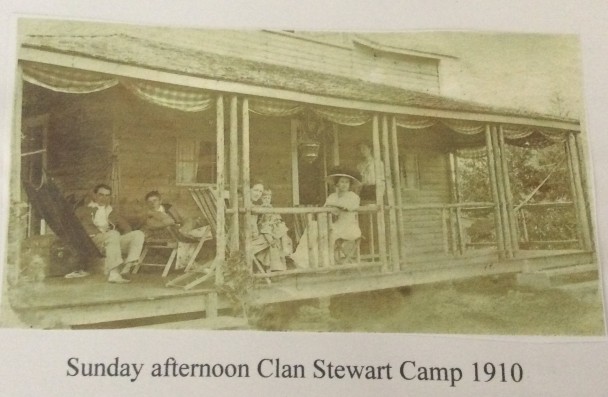
During the 1900s the Fleming family formed a deep and abiding love for the Fishing Islands at Oliphant, on the Lake Huron side of the Bruce Peninsula.  Attracted by the rugged nature of the islands, the abundant fishing, and the beautiful blue waters, they established camps in the very early 1900s on Main Station, Little Squaw, Sunset, Frog, and others.  Clan Stewart Camp on Little Squaw continues as a family gathering place. Roy Fleming, Ruth Larmour’s grandfather, and Roy’s Aunt Jennie bought this parcel of land in 1909 on Indian Channel and built a Victorian cottage.  They named their cottage Clan Stewart Camp after Jennie’s mother, Jean Stewart Fleming. The cottage has been modified a few times since, but its porch is still a favourite place for lounging in the afternoon.

The story of the early Fleming campers, their descendants, and of Clan Stewart Camp is told in “The Fleming Family – Early Oliphant Campers'” published in the Yearbook Edition 2017 of the Bruce County Historical Society.  Ruth Larmour is the narrator  with tales of early cottage life, the changing connections of family with the islands, and her own deep attachment.

Read the full article at  Fleming-Oliphant-Version3a-2017.pdf (in Dropbox)