Laird of Cragganfearn

Cragganfearn, Logierait Parish, Scotland in 2018. Photo by Eddie Thomson
Cragganfearn, Logierait Parish, Scotland in 2018. Photo by Eddie Thomson (https://www.heartlandtours.co.uk/)

Many families have a story from the past that takes on mythic qualities in the retelling. In genealogy, however, it is important to examine the story critically and evaluate the evidence. (1)

The Fleming family’s story has been about the “laird of Cragganfearn”,  the belief that Alexander Fleming’s grandfather had been “laird of Cragganfearn”, an estate of some 260 acres in the central part of the Atholl region of Perthshire. As the story goes, Alexander Fleming’s father, John, met his future wife Janet Ross at Cragganfearn where she was a servant. John’s father, the laird, banned the marriage and disinherited his son when John disobeyed. Very romantic, but how much is true? To be a laird means owning a substantial estate. Did a Fleming own that estate?

Others have wondered. In 2006 there was a heated thread at Rootschat in which three Fleming descendants sought information about the laird. One respondent (not a descendant) with the handle Tickle pointed out that the entire area had been owned by the Duke of Atholl in the 1700s, and that rental records at the Blair Estate in Blair Atholl (north of Logierait and Cragganfearn) would have the answer.

We examine the sources of this story, the information itself, and the evidence from land records and other accounts. We will see that the “lairdship” story began as wishful thinkin and continued thus. Continue reading

Time-Travel to Scotland

Excerpt for Logierait Parish from the New Statistical Account of Scotland (1838-1845) Vol X Perth. Source: Internet Archive

Outside of watching the TV Series Outlanders for its historical time-travel into the Scottish Highlands in the 1700s (or, of course, reading the novels by Diana Gabaldon’s on which the series is based), our best method for learning about the people and places of the time is through resources on the Internet. This may be a less entertaining way, but it can be rewarding. In researching the Scottish background about the Fleming Family, we have dug into several tremendous resources about Scotland’s past that includes historical accounts, maps, drawings and images, and fiction.

The Scots, with great foresight, undertook two extensive and detailed accounts of the geography, population, economy and society in the late 1790s and mid-1800s. The First (or Old) Statistical Account of Scotland (1792-99) in 21 volumes was compiled by Sir John Sinclair who engaged over 900 ministers in the parishes to report on their areas guided by his questions. The Second (or New) Statistical Account of Scotland (1834-45) was done for the Society for the Benefit of the Sons and Daughters of the Clergy in Scotland and was produced similarly.

Both may be searched and read in digital format through Statistical Accounts of Scotland Online, a superbly rich website. Use the clickable map to zoom into a county and then browse from the list for a parish, or use a keyword search. Locating the parish – for example, Logierait – leads to links to the digitized images in the sections in the Old and New Statistical Accounts. This resource was created by EDINA, a division of the University of Edinburgh’s Information Services. Searching and viewing are free, but a fee-based subscription is needed to have access to transcripts, downloads, printing, enhanced searching, and other personalized features.

Continue reading

Home to Perthshire: July 11 – July 23, 1903

After a long day’s journey across Scotland, Roy Fleming, his Aunt Jennie, his Uncle James and his cousin Minnie arrived in Dunkeld, Perthshire, 11 July 1903.

We land at Dunkeld 8:10+. Bella and Jeannie Smith are there to meet us. Send our grips down to Mrs. Duff’s with Mr. Fisher, and we six walk down and call at Smith’s house where we are welcomed. [From Roy’s Journal]

The Smiths were relatives on the Stewart side – Roy’s father’s mother. Jean Stewart’s sister Margaret married Alexander Robertson, and their daughter Elizabeth married Hugh Smith. Roy said of Elizabeth – “Mrs Smith is very much like Aunt Jessie [Jessie Agnew]– inclined perhaps to be a little more jokey.” Bella and Jeannie, delightful young women of 26 and 24 years, were Mrs. Smith’s (Elizabeth’s) daughters – Jeannie was a bookkeeper and Bella “a 1st assistant in P.O and a telegraph operator”. Roy later praised Bella to his cousin C.A. Fleming in Owen Sound as “handsome, clever and bright” and “the most genteel person” he met in Scotland. (Perhaps Roy was smitten.)(1)  Tom and Andrew, who are often mentioned in the journal, were young men of 25 and 21 years, both employed as blacksmiths. (There were three other daughters: Margaret, Jessie, and Elizabeth). (2)

The next day, the Flemings joined the Smith family at the Sunday service in the Dunkeld Cathedral, and repaired to the Smiths afterwards. They would spend the next ten days, until July 23, touring old family haunts, visiting relatives and friends, walking the hills of Perthshire, and absorbing every moment.

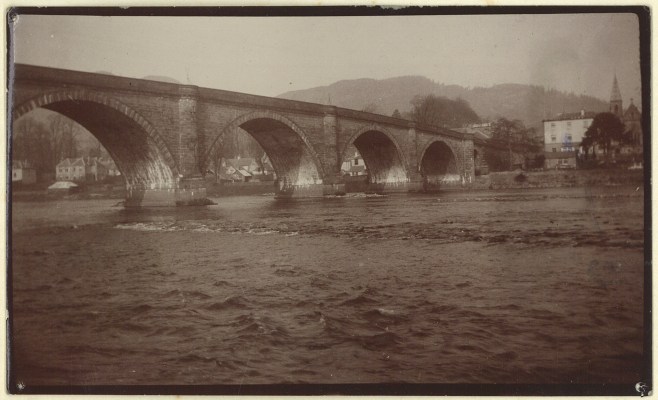
Dunkeld Bridge, July 1903, photo taken by Roy Fleming
Dunkeld Bridge over the Tay River, photo taken by Roy Fleming, July 1903 (Fleming Family Papers)

They were staying at Mrs. Duff’s on Atholl Street in Dunkeld. During their stay, James told the story that when he was a schoolboy he had been egged on to fight Duff – he refused until Duff called him a coward. Later Mrs. Duff, rather than scolding James, gave him “a piece of head cheese and oat bannock and asked him not to hurt her boy anymore.” Might this family have been related to the “young Duff” James had known?

Continue reading

Touring Robbie Burns’ Country

Previous blog postings introduced The Trip of a Lifetime that the Flemings took in 1903 to the British Isles and Europe and described their ocean voyage on the R.M.S. Tunisian. In this posting, we follow them in their pilgrimage to Ayrshire, land of Robbie Burns; a quick trip to Belfast; and a tour through Loch Lomand and the Trossachs. Many thrills lay ahead for Roy, his cousin Minnie, their Aunt Jennie, and James (Minnie’s father, Jennie’s brother), as they visited places they had read about in literature and Scottish histories.

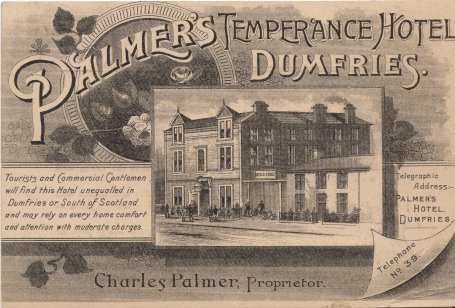
They travelled at a pace so dauntingly fast it would challenge young people today, let alone more senior-aged travellers like Jennie and James. On arrival in Liverpool, July 6, 1903, the Flemings moved quickly, taking a cab to the Liverpool and Manchester Railway Station on Lime Street in the centre of town. Not a moment to waste, they visited St George’s Hall and Walker’s Art Gallery (where they noted the statues of Michelangelo and Raphael at the entrance), before boarding the London and North Western Railway to head north to Robbie Burns’ country. With their luggage – we hope they were travelling light – they changed trains in Carlisle to the Glasgow, Dumfries and Carlisle Railway, which passed through Gretna Green (famous for “runaway marriages”), and arrived in Dumfries at 7 pm that evening. After finding their hotel – the Palmer’s Temperance Hotel – and seemingly energized, they went for a walk around town – for Dumfries was where Robert Burns had lived his last three years.

Palmer's Temperance Hotel, Dumfries
Palmer’s Temperance Hotel, Dumfries

Jennie found Dumfries a “beautiful clean city – streets so pretty and clean and situated on the Nigh River.” They came upon the Globe Inn where Burns used to drink. Jennie did not dare to enter, but Roy and James did and James, sitting in Burn’s chair, sang a stanza of “Willie brewed a peck o’ malt”. They made their way through narrow, crooked streets to 16 Burns Street where Mrs. Brown, Burns’s granddaughter, showed them the house in which he had died in 1796.

Continue reading

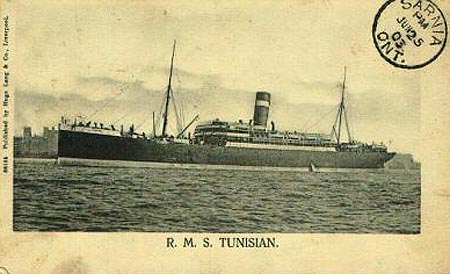
R.M.S. Tunisian – Montreal to Liverpool – June 27 to July 6, 1903

R.M.S. Tunisian - postcard postmarked Sarnia June 25, 2003
R.M.S. Tunisian – postcard 1903.  Courtesy Simplon Postcards, The Passenger Ship Website

Boarding in Montreal, the Fleming party settled into their quarters on the Tunisian at 7:30 pm Friday, June 26. Roy noted – “We put baggage in our rooms. Mine is Room 126 Berth 2, Uncle James 126-4. Aunt Jennie 128 – 2 – Minnie 128-4.” They were on the Upper Deck, in cabins on the outside wall. The Saloon Deck with the dining, music, and smoking saloons for second class and first class was above. The two top decks were the Bridge for First Class and the Promenade deck .

The Norway Heritage website has a full history of the Tunisian with postcards and the cabin floor plan.

With advances in steamer technology and ship design, travelling to Great Britain and the continent had become more comfortable and increasingly fashionable. They were travelling second (cabin) class in rooms that accommodated four people. Roy immediately remarked, “Rather neat appearance of rooms and dining rooms. Music Room and Smoking Room.”

Continue reading